
Gold Deposits in South Africa: Major Active Mines and Production
Gold Deposits in South Africa: South Africa’s six largest active gold deposits are South Deep (Witwatersrand Basin, Gold Fields), Mponeng (West Wits Line, Harmony Gold — the world’s deepest gold mine), Moab Khotsong (Klerksdorp Goldfield, Harmony Gold), the Kloof-Driefontein Complex (West Rand, Sibanye-Stillwater), the Barberton Greenstone Belt (Pan African Resources), and the Evander Goldfield’s Egoli and Rolspruit projects (also Pan African Resources).
Together with dozens of smaller operations, these deposits produced approximately 88.5 tonnes of gold in 2025 — down from a 1970 peak of 1,000 tonnes annually, but experiencing genuine renewed investment as gold trades at historically elevated prices.
South Africa’s relationship with gold is unlike that of any other country on earth. Since the first discovery of commercial gold in the Witwatersrand Basin in 1886, South Africa has produced over 50,000 metric tonnes of gold — roughly 40% of all the gold ever mined in human history.
The Rand Refinery in Germiston, the only African member of the London Bullion Market Association (LBMA), has alone refined more than 50,000 tonnes of gold throughout its history, processing virtually all of South Africa’s large-scale mine output.
Despite a significant structural decline from that 1970 peak, South Africa remains one of the most geologically significant, institutionally credible, and investment-relevant gold jurisdictions in the world.
This guide from Africa Gold Suppliers Limited covers the six largest gold deposits, current gold prices, the companies operating these deposits, the geology behind South Africa’s extraordinary gold wealth, and how international buyers can access certified South African gold through a trusted, licensed dealer.
Major Active Mines and Production
| Mine | Operator | Location | Reef/Deposit Type | Recent Annual Production | Reserves |
|---|---|---|---|---|---|
| South Deep | Gold Fields | Gauteng | Witwatersrand paleoplacer | ~321,000 oz | ~32.8 Moz proven & probable |
| Mponeng | Harmony Gold | Gauteng (Carletonville) | Carbon Leader / VCR | ~200,000 oz | ~5.3 Moz |
| Moab Khotsong | Harmony Gold | North West (Klerksdorp) | Witwatersrand | ~445,000 oz | ~2.5 Moz |
| Kloof-Driefontein (KDC) | Sibanye-Stillwater | Gauteng (West Rand) | South Reef | ~518,000 oz | ~7.8 Moz |
| Barberton (4 mines) | Pan African Resources | Mpumalanga | Orogenic quartz vein | ~150,000 oz | ~1.66 Moz |
| Evander (Egoli/Rolspruit) | Pan African Resources | Mpumalanga | Witwatersrand-equivalent | Development stage | ~4.5 Moz (Egoli) |
Together, Harmony Gold, Sibanye-Stillwater, and Gold Fields account for approximately 76% of South Africa’s industrial gold output, virtually all of it refined through the LBMA-accredited Rand Refinery. Detailed profiles of each deposit follow below.
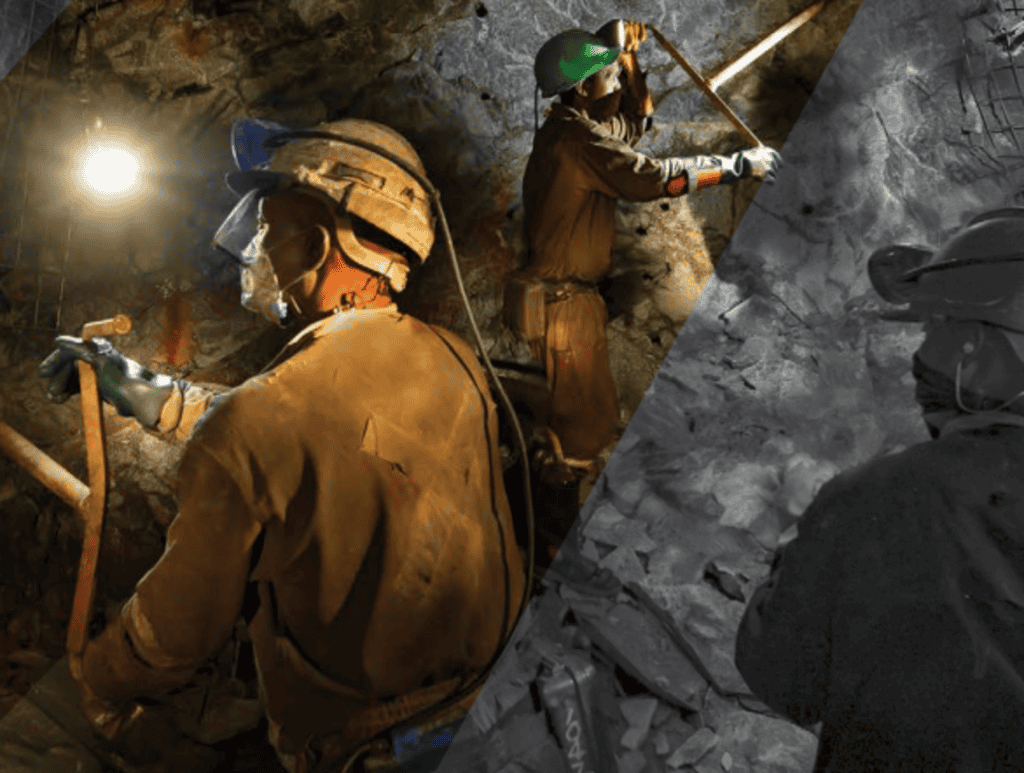
The Geological Foundation — Why South Africa’s Gold Deposits Are Unlike Any Other
South Africa’s extraordinary gold wealth rests on a unique geological structure: the Kaapvaal Craton, one of the oldest and most stable pieces of continental crust on earth, dating back over 3.6 billion years.
This ancient crustal block forms the basement across South Africa and Zimbabwe, and it’s within one of its preserved sedimentary basins — the Witwatersrand Basin — that the world’s largest gold deposit formed and remains partially intact today.
The Witwatersrand Basin is an elliptical sedimentary structure approximately 400 kilometres across, extending beneath Gauteng, the Free State, and North West provinces.
Between roughly 3.0 and 2.7 billion years ago, eroding highlands fed rivers that deposited sediments — primarily quartz-pebble conglomerates, sandstones, and shales — into a shallow inland sea or lake.
Gold, carried by these ancient river systems, settled by density into the coarser conglomerate layers, creating the paleoplacer deposits that define the Witwatersrand system.
These gold-bearing layers — known as reefs — are typically less than a metre thick but traceable laterally for kilometres, sometimes across the full 400-kilometre extent of the basin.
Key economic reefs include the Carbon Leader Reef, Basal Reef, Vaal Reef, and Ventersdorp Contact Reef, with gold mineralisation typically associated with pyrite, uranium, and carbonaceous material.
Two subsequent geological events preserved this deposit for modern mining. A massive meteorite impact at Vredefort, approximately 2.02 billion years ago, formed the Vredefort Dome (now a UNESCO World Heritage Site) and uplifted the basin’s western reefs, exposing them at surface and enabling the first discoveries.
Later volcanic activity from the Ventersdorp Supergroup lavas (approximately 2.715 billion years ago) sealed the basin beneath impermeable cover, protecting its gold-bearing reefs from erosion.
Beyond the Witwatersrand, South Africa hosts important secondary gold deposits in Archean greenstone belts in Mpumalanga (Barberton), Limpopo (Murchison), and North West Province (Amalia-Kraaipan). These orogenic deposits — formed by hydrothermal fluids moving through fault zones during ancient mountain-building events — host gold in quartz veins within sheared greenstones, yielding higher grades than the Witwatersrand paleoplacers despite a smaller overall resource footprint.
The 6 Largest Gold Deposits in South Africa
1. Witwatersrand Basin — South Deep Deposit (Gauteng, Free State, North West)
The Witwatersrand Basin is the largest gold deposit ever discovered on earth — an elliptical area approximately 400 kilometres across three provinces that has produced over 50,000 tonnes of gold since 1886, with an estimated 5,000–6,000 tonnes of recoverable reserves remaining (broader resource estimates including sub-economic material run as high as 36,000 tonnes).
The principal active operation on the western portion of the basin is South Deep Mine, operated by Gold Fields at depths of up to 3 kilometres. South Deep holds proven and probable reserves of approximately 32.8 million ounces — one of the largest reserve bases of any producing gold mine in the world.
Recent annual production runs around 321,000 ounces, with Gold Fields’ $50 million solar investment (50 MW capacity) reducing dependence on South Africa’s constrained electricity grid and lowering all-in sustaining costs.
Ore grades average approximately 5.13 g/t, with refined output at 99.99% purity following cyanidation at the on-site plant. Gold Fields expects South Deep to maintain production for well beyond 70 years at current reserve estimates — one of the longest remaining mine lives of any gold operation globally.
The basin also encompasses the West Rand and Far West Rand goldfields, where most of South Africa’s historical high-output production occurred. While the shallowest, highest-grade zones are depleted, deeper extensions and tailings reprocessing continue contributing meaningfully to national output.
2. West Wits Line — Mponeng Deposit (Gauteng, Carletonville)
Mponeng, in Gauteng’s West Wits goldfield near Carletonville, is the world’s deepest active gold mine — a striking demonstration of modern deep-mining engineering. Operated by Harmony Gold since its 2020 acquisition from AngloGold Ashanti, Mponeng exploits the Carbon Leader and Ventersdorp Contact Reefs at depths exceeding 4 kilometres, requiring decades of innovation in ventilation, refrigeration, seismic monitoring, and materials transport.
Proven and probable reserves stand at approximately 5.3 million ounces at grades averaging 8.53 g/t — among the highest average grades of any operating gold mine in the world. Annual production runs around 200,000 ounces, refined to 99.99% purity. At current gold prices, Mponeng generates compelling margins even with all-in sustaining costs of approximately $1,400–1,600/oz driven by its extreme operating depth.
The Mponeng ore body remains geologically open at depth, with exploration drilling continuing to extend the known resource below the current mining horizon. South Africa opened its first new underground gold mine in 15 years in late 2025 at Qala Shallows, adjacent to Mponeng, targeting initial production of 70,000 ounces per year scaling toward 200,000 — a signal that the West Wits goldfield is entering a new investment cycle.
3. Klerksdorp Goldfield — Moab Khotsong Deposit (North West Province)
Moab Khotsong sits in the North West Province’s Klerksdorp goldfield, within the southern arc of the Witwatersrand Basin, covering approximately 15 square kilometres at depths of 1.5–2 kilometres and targeting tabular gold and uranium-bearing reefs.
Proven reserves stand at approximately 2.5 million ounces, with ore grades averaging 4–6 g/t processed to 99.99% purity. Harmony Gold operates the mine, which produced approximately 445,000 ounces recently — one of the most significant single-shaft gold operations remaining in South Africa.
Harmony has extended the mine’s life through tailings integration, recovering residual gold from historical surface dumps at 5–10 g/t grades, alongside investment in 30 MW of renewable energy capacity.
4. West Rand — Kloof-Driefontein Complex (Gauteng)
The Kloof-Driefontein Complex (KDC), operated by Sibanye-Stillwater, is one of the largest remaining gold mining complexes in South Africa, spanning approximately 100 square kilometres with 17 active shafts targeting South Reef conglomerates at depths of up to 2.2 kilometres — the consolidation of two historically separate Witwatersrand operations.
Combined reserves total approximately 7.8 million ounces (3.6 million at Kloof, 4.2 million at Driefontein), with ore grades of 5–7 g/t and refined output at 99.99% purity. Combined production recently ran around 518,000 ounces via sequential grid mining methods that manage seismic risk in narrow-reef deep mining.
Sibanye-Stillwater has invested in automation and remote-operated machinery, with Black Economic Empowerment partnerships holding 30% ownership stakes. Current estimated mine life is 10+ years, with extension potential through tailings reprocessing.
5. Barberton Greenstone Belt (Mpumalanga Province)
The Barberton greenstone belt, roughly 350 kilometres east of Johannesburg near the Eswatini border, is South Africa’s most significant orogenic gold deposit system — a striking geological contrast to the Witwatersrand paleoplacers. Barberton’s gold is hosted in hydrothermal quartz veins within sheared Archean greenstone sequences up to 3.5 billion years old, among the oldest exposed rocks on earth.
Pan African Resources operates four mines across the belt — Consort, Fairview, Sheba, and New Consort — from a combined resource base of approximately 1.66 million ounces (52 tonnes). What Barberton lacks in scale compared to Witwatersrand, it makes up for in grade: 10–20 g/t in the higher-quality quartz vein intersections, refined to 99.99% purity.
Annual production runs around 150,000 ounces from a combination of open-pit and underground methods, with Pan African Resources powering operations through 12 MW of solar capacity via its Evander solar installation.
The belt has supported 140 years of continuous mining, with the nearby Pilgrim’s Rest and De Kaap goldfields — among South Africa’s first mining areas, predating the 1886 Witwatersrand discovery — still holding residual interest for junior exploration.
6. Evander Goldfield — Egoli and Rolspruit Projects (Mpumalanga)
The Evander goldfield hosts the Egoli and Rolspruit projects — advanced-stage deposits representing a significant part of South Africa’s new-generation production pipeline at current gold prices.
Pan African Resources operates Evander, with Egoli holding resources of approximately 4.5 million ounces and Rolspruit an underground development target that has attracted renewed study as gold economics have improved.
Evander exploits Witwatersrand-equivalent reef horizons extending eastward from the main Gauteng basin, at shallower depths than Mponeng or KDC but with equivalent gold grade and reef character.
The Qala Shallows project — South Africa’s first new underground gold mine in 15 years — sits partly within the broader Evander system, targeting 70,000 ounces per year from relatively shallow (800–1,500 metre) reef horizons.
Theta Gold Mines also plans to bring its TGME operation online near Pilgrim’s Rest by 2027, with capacity of 160,000 ounces per year over its first five years — further evidence of the sector’s new investment cycle.
Current Gold Price in South Africa
Gold is trading at historically elevated levels through 2026, following an all-time high of approximately $5,590 per troy ounce set in late January 2026. With the South African rand trading around R16.2–16.4 per USD, current pricing translates to:
| Weight | Price (ZAR) | Price (USD) |
|---|---|---|
| Per gram (24K) | R2,230 – R2,315 | $137 – $142 |
| Per 10 grams | R22,300 – R23,150 | $1,370 – $1,420 |
| Per 100 grams | R223,000 – R231,500 | $13,700 – $14,200 |
| Per kilogram | R2,230,000 – R2,315,000 | $137,000 – $142,000 |
| Per troy ounce | R69,400 – R72,050 | $4,260 – $4,420 |
Gold prices move daily — always confirm the live rate before transacting. Deposits that were marginal at $1,500/oz are highly profitable at current prices, which is why the South African gold sector is experiencing renewed investment interest after decades of decline. For buyers looking to purchase certified gold bars from South Africa, Africa Gold Suppliers Limited provides real-time, spot-referenced pricing — contact us for a current quote.
South Africa’s Gold Production — Current Trends
South Africa produced approximately 88.5 tonnes of gold in 2025 — a 1.9% decline from the prior year, per the Minerals Council of South Africa. This represents a dramatic long-term decline from the historic 1970 peak of 1,000 tonnes: South Africa produced 605 tonnes in 1990, 300 tonnes in 2005, and approximately 100 tonnes in 2024.
The structural drivers — increasing mining depths, depleting high-grade reef horizons, chronic electricity supply constraints, and rising labour and energy costs — haven’t disappeared.
But at current elevated gold prices, the economics of South Africa’s deep gold mines are fundamentally different from a decade ago at $1,500/oz.
The Rand Refinery’s LBMA accreditation means South African gold bars carry the highest international credibility available in the global wholesale market. For buyers seeking investment-grade bullion with Rand Refinery provenance, Africa Gold Suppliers Limited can source and supply this material with full documentation and insured international delivery.
Gold Grade and Quality — A Buyer’s Guide
Witwatersrand deep-rock deposits currently yield average ore grades of approximately 2.9–8.5 g/t depending on reef and operation — Mponeng leads at 8.53 g/t, exceptional for a large-scale underground mine, while the basin-wide average has declined to roughly 2.9 g/t as higher-grade surface-accessible reefs have depleted. All Witwatersrand ore is processed via cyanidation, achieving 90%+ gold recovery and producing refined bullion at 99.99% purity (24K) at the Rand Refinery.
Barberton orogenic deposits yield significantly higher grades of 10–20 g/t in the best quartz vein intersections — classified as “free-milling” in the higher-grade zones, meaning gold can be recovered by gravity concentration and direct cyanidation without the complex pre-treatment refractory Witwatersrand ore requires.
Once refined to 99.99% purity at the Rand Refinery, the source deposit becomes commercially irrelevant to the buyer: a 24K bar refined from Mponeng concentrate is chemically and commercially identical to one refined from Barberton ore. What matters for buyers is the assay certificate, serial number, and documentation chain.
Brief History of Gold Mining in South Africa
George Harrison’s 1886 discovery of gold in the Witwatersrand conglomerate reefs at Langlaagte Farm triggered the most consequential gold rush in African history — within ten years, Johannesburg grew from scattered mining camps to a city of 100,000 people.
By 1899, the Witwatersrand was producing approximately 30% of global gold output and had attracted over £75 million in British investment capital, making control of the goldfields a central cause of the Anglo-Boer Wars of 1899–1902.
South Africa’s output peaked at approximately 1,000 tonnes per year in 1970 — nearly 67% of global mine production at the time, a dominance no single country has matched before or since.
The subsequent decline accelerated through the 1980s and 1990s as accessible high-grade reefs were exhausted and operating depths drove up costs.
Post-apartheid, the 1994 Mining Charter mandated Black Economic Empowerment ownership requirements that reshaped the sector’s corporate structures, and AngloGold Ashanti’s 2020 exit from all South African operations — selling remaining assets to Harmony Gold — marked a symbolic end to the colonial-era ownership model defining South African gold mining since 1886.
Major Gold Mining Companies
Harmony Gold Mining is South Africa’s largest gold producer, operating eight underground mines, one open-pit mine, and four tailings retreatment facilities, including Mponeng and Moab Khotsong.
Harmony is targeting 1.5 million ounces per year and has invested in 30 MW of installed solar capacity with plans for a further 137 MW toward energy independence from Eskom.
Sibanye-Stillwater operates the Kloof-Driefontein Complex and the Beatrix Mine, and holds majority ownership of DRDGOLD, which specializes in tailings reprocessing. The company has secured multi-year wage agreements incorporating 6–7.5% annual increases above inflation, reducing strike risk and improving project finance predictability.
Gold Fields operates South Deep as its sole South African gold asset, having exited all other South African operations in prior years, and has invested $50 million in a 50 MW solar plant at the mine.
Pan African Resources operates the Barberton and Evander goldfields, producing approximately 150,000 ounces per year with strong ESG credentials including community trust investments and solar power integration.
DRDGOLD, majority-owned by Sibanye-Stillwater, specializes in reprocessing historical tailings dumps, recovering 5–10 g/t gold from surface material while remediating acid mine drainage risk as a co-benefit.
Environmental and Social Considerations
Acid mine drainage (AMD) is South Africa’s most significant gold mining legacy environmental issue — approximately 6,000 legacy mining sites contribute acid-laden water to South Africa’s river systems, affecting agricultural land, water supplies, and biodiversity across the Witwatersrand Basin and downstream catchments. DRDGOLD’s tailings reprocessing addresses AMD risk as a co-benefit of gold recovery.
Illegal mining, conducted by criminal networks operating as “zama zamas” in abandoned or active workings, is estimated to account for 10–30% of South Africa’s total gold output depending on measurement methodology, with the Department of Mineral Resources and Energy estimating annual losses exceeding R14 billion. This is exactly why documentation and traceable chain-of-custody isn’t optional for buyers of South African gold — it’s a legal and commercial necessity.
Black Economic Empowerment (BEE) requirements under South Africa’s Mining Charter mandate minimum 30% Black ownership in mining companies, with ongoing requirements for community benefit programmes, employee share ownership, and preferential procurement — shaping the corporate structure of every major operator and increasingly integrated into the ESG frameworks institutional investors use to evaluate mining stocks.
Investing in South African Gold — What to Know
The investment case operates on two levels: buying physical bullion produced from South African deposits, or investing in the mining companies operating them.
Physical gold is the most straightforward route for most buyers. South African Rand Refinery bars in sizes from 1 gram to 1 kilogram are internationally recognised, LBMA-credentialed, and carry some of the most trusted hallmarks in the global gold market. Investment-grade gold at 99.5%+ purity is VAT-exempt in South Africa when purchased from licensed dealers; Capital Gains Tax applies on profitable resale, so keep all purchase receipts and certificates for SARS reporting.
South African Krugerrand gold coins — first minted in 1967, available in 1 oz, ½ oz, ¼ oz, and 1/10 oz denominations — remain one of the most liquid gold investment products in the world, with an established global secondary market.
Mining company investment via JSE-listed shares or global ADRs in Harmony Gold (HMY), Sibanye-Stillwater (SBSW), Gold Fields (GFI), or Pan African Resources provides leveraged exposure to the gold price, typically amplifying moves 2–3x in equity returns during bull markets. Bullion-backed ETFs on the JSE offer exposure without individual share-selection risk.
Key risks: South Africa’s remaining reserves are deep and structurally declining, with the Minerals Council estimating fewer than 30 years of production at current rates. Electricity supply costs remain a material challenge despite accelerating renewable investment, and rand volatility relative to the USD adds an exchange-rate dimension worth explicitly modelling into any South African gold investment.
Gold Tourism and Heritage Sites
South Africa’s gold mining legacy is a living historical and geological experience. Gold Reef City in Johannesburg recreates the 1886–1900s gold rush era with underground tours into the Crown Mines No. 14 shaft (historically 750m deep), working stamp mills, and heritage buildings, adjacent to the Apartheid Museum’s political context.
Kromdraai Mine near Krugersdorp, site of one of the earliest Witwatersrand concessions (granted 1881), offers guided walks through original 140-year-old tunnels. The nearby Sterkfontein Caves, a UNESCO World Heritage Site within the Cradle of Humankind, add deep geological time context.
The Barberton Museum of Local History documents the 1884–1886 Barberton gold rush that preceded the Witwatersrand discovery, and the Vredefort Dome — the meteorite-impact structure that helped expose the Witwatersrand reefs — is itself a UNESCO World Heritage Site.
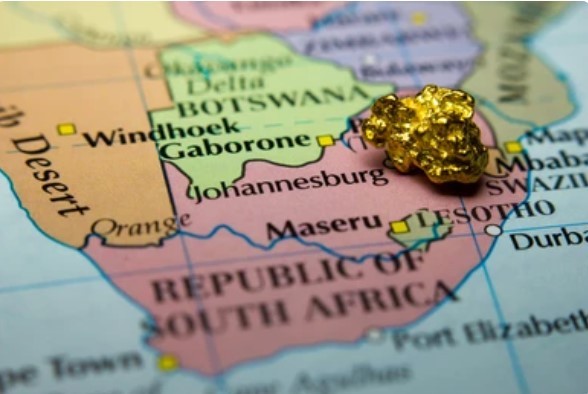
Buy Certified South African Gold
Africa Gold Suppliers Limited is your licensed, trusted partner for sourcing certified South African gold with full documentation, competitive pricing, and insured international delivery.
Whether you want 1 gram gold bars as entry-level fractional gold, 100 gram Rand Refinery bars for a growing portfolio, or 1 kilogram investment gold at the most competitive per-gram premium, we can supply certified 24K gold at current LBMA-referenced prices with complete assay documentation and Certificate of Origin.
We also supply gold nuggets from South African alluvial operations, doré bars for refineries and bulk investors, and raw gold for buyers with in-house processing capability.
Alongside South African product, our broader African supply network covers Uganda, the DRC, Tanzania, and other producing countries — giving you mine-direct access across multiple markets through one compliant, experienced supplier. See our buying gold and silver in South Africa guide and current South African gold bar pricing page for more.
Contact Africa Gold Suppliers Limited today for a personalised quote on current South African gold bar prices and availability.
Related Pages
- Buy Gold and Silver in South Africa
- Gold Bars Price in South Africa
- Buy Gold in Uganda
- Buy Gold in Congo
- Buy Gold Bullion from Mwanza (Tanzania)
- Who Can Export Gold from Zimbabwe
- Buy Gold Bars from Africa
- African Gold Bars for Sale
- Gold Producing Countries in Africa
- Gold Refineries in Africa
- Gold Mining
- Minerals
- FAQs About Buying Gold in Africa
- How to Buy Gold Online Safely
- Exporting Gold Bullion
- About Us
- Contact Us