
Top 20 Gold Producing Countries in Africa (2026 Update)
Explore the top gold producing Countries in Africa, including Ghana, South Africa, Mali, Burkina Faso and Sudan, and learn about Africa’s major gold mining regions and production.
Africa is the world’s leading gold-producing region, generating over 1,010 tonnes annually and accounting for roughly 20–25% of global output. Ghana leads the continent as the single largest producer, followed by South Africa, Mali, Burkina Faso, and Sudan rounding out the top five — though it’s worth being upfront that exact production figures genuinely vary across sources depending on whether artisanal output is included and which reporting year is used.
Which African Country Produces the Most Gold?
Ghana produces the most gold in Africa, with 2025 output estimates ranging from roughly 141 to as high as 187 tonnes depending on the source and methodology used.
This wide range reflects a genuine, ongoing feature of African gold statistics — industrial mine output is tracked precisely, but artisanal and small-scale mining, which makes up a substantial share of total production in several countries, is harder to measure with the same accuracy, and different bodies (the World Gold Council, national mining authorities, and industry trackers like Metals Focus) sometimes report meaningfully different totals for the same year.
Top 5 Gold Producing Countries in Africa
South Africa’s Mponeng mine remains the deepest gold mine on Earth, Mali’s Loulo-Gounkoto complex anchors West Africa’s second-largest producer, and Sudan’s artisanal sector has driven the fastest production growth of any African country over the past decade. Here’s how the top five actually stack up:
| Rank | Country | 2025 Output (Estimated, tonnes/yr) | Key Mines |
|---|---|---|---|
| #1 | Ghana | ~141–187 (source-dependent) | Obuasi, Tarkwa, Ahafo |
| #2 | South Africa | ~98–118 | Mponeng, TauTona, Driefontein |
| #3 | Mali | ~100 | Loulo-Gounkoto, Fekola |
| #4 | Sudan | ~50–93 | Hassai, Gabgaba, Ariab |
| #5 | Burkina Faso | ~62–94 | Essakane, Mana, Taparko |
Figures compiled from World Gold Council data, Metals Focus reporting, and national mining authority statistics. Given genuine reporting variance across sources — particularly for countries with large artisanal sectors — treat these as informed estimates rather than precise, universally agreed figures.
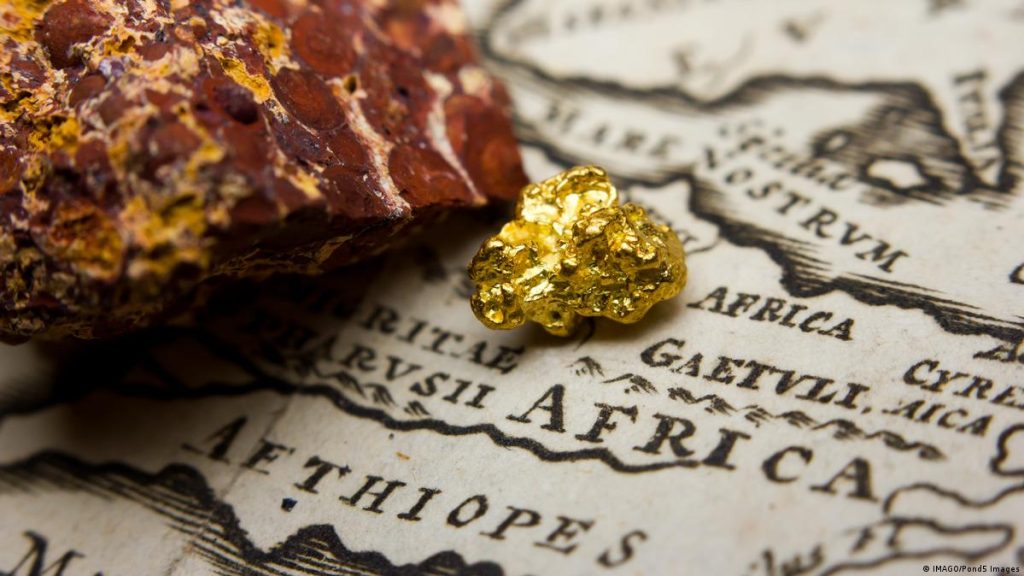
Top Gold-Producing Countries in Africa: All 20 African Gold Producers
Africa’s total annual gold output exceeds 1,010 tonnes, spread across 20 countries with meaningfully different production scales, mining models, and growth trajectories.
| # | Country | Output (t/yr, est.) | Key Mines / Regions | Notable Factor |
|---|---|---|---|---|
| 1 | Ghana | 141–187 | Obuasi, Tarkwa, Ahafo | Africa’s #1 producer |
| 2 | South Africa | 98–118 | Mponeng, TauTona, Driefontein | Deepest mines on Earth |
| 3 | Mali | ~100 | Loulo-Gounkoto, Fekola | Top West Africa exporter |
| 4 | Sudan | 50–93 | Hassai, Gabgaba, Ariab | Artisanal-driven; key FX earner |
| 5 | Burkina Faso | 62–94 | Essakane, Mana, Taparko | Fast growth; security challenges |
| 6 | Tanzania | ~46 | Geita, Bulyanhulu, North Mara | East Africa’s leading producer |
| 7 | DR Congo (DRC) | ~36 (official) | Kibali, North & South Kivu | Official figures substantially understate true output |
| 8 | Côte d’Ivoire | ~34 | Tongon, Ity | Rapid sector growth |
| 9 | Zimbabwe | ~23 | Blanket, Freda Rebecca | Top FX earner |
| 10 | Guinea | ~20 | Lefa | Bauxite + gold dual economy |
| 11 | Senegal | ~12 | Sabodala-Massawa | Rising West Africa producer |
| 12 | Egypt | ~16 | Sukari (Centamin) | Ancient tradition, modern expansion |
| 13 | Ethiopia | ~10 | Lega Dembi | Emerging, FDI-friendly |
| 14 | Namibia | ~7 | Navachab, Otjikoto | Diversifying from diamonds/uranium |
| 15 | Liberia | ~7 | New Liberty (Avesoro) | Largely unexplored potential |
| 16 | Mozambique | ~4 | Central/northern artisanal | Formalisation underway |
| 17 | Nigeria | ~4 | Northwest artisanal | Diversifying from oil |
| 18 | Cameroon | ~3 | East/North artisanal | Regulatory reform in progress |
| 19 | Niger | ~3 | Samira Hill | Uranium-plus-gold economy |
| 20 | Central African Republic | 1–2 | Artisanal nationwide | High potential, improving stability |
Sources: World Gold Council, Metals Focus, African Minerals Development Centre, national mining authority reports. Artisanal production estimates in particular may vary by ±10–15% or more between sources.
Country Profiles: Africa’s #6–10 Gold Producers
Tanzania is East Africa’s leading gold producer, and DR Congo’s true output substantially exceeds its official figures due to widespread smuggling from its eastern provinces. Here’s a fuller look at how each of the next five producers actually operates.
Tanzania (#6, ~46 tonnes/year) — East Africa’s largest gold producer, anchored by the Lake Victoria Goldfields, a geological formation stretching across the country’s northwestern region. AngloGold Ashanti’s Geita mine and Barrick’s Bulyanhulu and North Mara operations produce gold at some of the lowest unit costs on the continent.
Tanzania has also required a minimum government equity stake in new mining projects as part of a broader push to increase the state’s financial share of mining revenue, a reform that has increased state earnings without meaningfully deterring the international investment continuing to flow into the sector.
DR Congo / DRC (#7, ~36 tonnes/year official) — one of Africa’s most significant gold territories by underlying geology, though its official output figure substantially understates true production given widespread smuggling from the country’s eastern provinces. North Kivu, South Kivu, and Ituri sit atop some of the richest artisanal gold deposits in the world, producing high-purity 22K to 24K gold.
The Kibali gold mine in Ituri Province, jointly operated by Barrick Gold and AngloGold Ashanti, is Africa’s single largest gold mine, producing over 680,000 ounces annually and generating substantial royalty revenue for the DRC state even as informal output elsewhere in the country continues to leak through undocumented channels.
Côte d’Ivoire (#8, ~34 tonnes/year) — has transformed into a major West African gold producer over the past decade, driven by significant international mining investment and a comparatively stable political environment.
Barrick’s Tongon mine and Endeavour Mining’s Ity operation anchor current production, and gold is rapidly diversifying an economy historically dependent on cocoa and coffee, generating billions in export revenue and thousands of formal-sector jobs. The country’s geology remains substantially under-explored, with ongoing drilling programmes continuing to delineate new deposits.
Zimbabwe (#9, ~23 tonnes/year) — gold is Zimbabwe’s single largest foreign currency earner, playing a genuinely pivotal role in the country’s ongoing economic recovery. Production centres on ancient greenstone belts across the central and southern regions, with Caledonia Mining’s Blanket Mine standing as the country’s flagship, consistently profitable operation.
Currency instability and periodic power shortages remain real operational challenges, though Zimbabwe’s longer-term gold production outlook is genuinely positive as investment returns to the sector.
Guinea (#10, ~20 tonnes/year) — best known internationally for enormous bauxite reserves, but its gold sector contributes meaningfully to national export revenue and continues growing.
Nordgold’s Lefa mine in northeastern Guinea is the country’s flagship gold operation, with AngloGold Ashanti’s Siguiri mine adding substantial additional output from the country’s gold-bearing Birimian greenstone belt — the same geological formation underpinning much of West Africa’s broader gold wealth.
Country Profiles: Africa’s #11–20 Gold Producers
Senegal has emerged as one of West Africa’s most investor-friendly new gold frontiers, while Egypt draws on a gold mining tradition spanning thousands of years. The remaining ten producers on this list each represent a different stage of African gold sector development.
Senegal (#11, ~12 tonnes/year) — a genuine rising star in West Africa’s gold sector, anchored by the Sabodala-Massawa Gold Complex, operated by Endeavour Mining. Senegal’s political stability and transparent mining code have made it one of the more investor-friendly new gold frontiers on the continent.
Egypt (#12, ~16 tonnes/year) — brings a gold mining tradition spanning thousands of years into the modern era, led by Centamin’s Sukari Gold Mine in the Eastern Desert. Ongoing government-backed exploration across the Eastern Desert and Red Sea Hills positions Egypt as a growing, if still comparatively modest, contributor to North African gold production.
Ethiopia (#13, ~10 tonnes/year) — one of the more exciting emerging gold investment destinations in East Africa. The Lega Dembi mine anchors current production, while new exploration licences across the country’s Precambrian gold belts are attracting real international interest as part of the government’s broader economic diversification strategy.
Namibia (#14, ~7 tonnes/year) — steadily building a gold sector alongside its more established diamond and uranium industries, with the Navachab and Otjikoto mines in production and ongoing exploration identifying further deposits across the country’s prospective geology.
Liberia (#15, ~7 tonnes/year) — one of Africa’s most genuinely underexplored gold territories, with vast Birimian greenstone belts covering much of the country. The New Liberty Gold Mine marks the early stage of what could become a substantial industrial gold sector over time.
Mozambique and Nigeria (#16–17, ~4 tonnes/year each) — both sit at the formalisation frontier of African artisanal gold mining, with significant underlying geological endowment where government-led reforms to legalise, document, and tax small-scale miners are gradually converting informal output into officially recorded production.
Cameroon, Niger, and Central African Republic (#18–20, 1–3 tonnes/year each) — round out the list, each representing an early-phase stage of gold sector development where political and infrastructure improvements could meaningfully unlock production growth over the coming decade, though current output remains genuinely modest compared to the continent’s leading producers.
Why Is Ghana Africa’s Largest Gold Producer?
Ghana leads African gold production because of a combination of geological richness, established industrial mining infrastructure, and a genuinely investor-friendly regulatory environment.
The country’s Ashanti Gold Belt hosts world-class mines operated by major international companies — Obuasi (AngloGold Ashanti), Tarkwa (Gold Fields), and Ahafo and Akyem (both Newmont) — while gold export earnings represent a substantial share of Ghana’s total foreign exchange revenue, with recent estimates ranging from roughly 40% to 90% of mineral exports depending on the measure used.
The establishment of the Ghana Gold Board (GoldBod) in 2025 has also brought greater centralization and traceability to the sector, part of why Ghana continues consolidating its lead over South Africa and other major producers.
Why Has South Africa’s Gold Output Declined?
South Africa’s gold output has declined from its early-1990s peak of over 600 tonnes per year primarily because its shallowest, most accessible reserves have been progressively depleted, forcing mining ever deeper — Mponeng mine now descends over 4,000 metres underground, making it the deepest gold mine on Earth.
Despite this decline, South Africa remains a globally significant producer, and the Witwatersrand Basin remains the single largest known gold deposit in human history.
The country’s established refining infrastructure, including Rand Refinery — Africa’s only LBMA Good Delivery-accredited gold refinery — keeps South Africa central to the continent’s gold supply chain even as raw output has fallen from its historic peak.
Which African Region Produces the Most Gold: West, East, or Southern Africa?
West Africa produces significantly more gold than any other African region, with Ghana, Mali, Burkina Faso, Côte d’Ivoire, Guinea, and Senegal together generating well over 400 tonnes annually — more than East and Southern Africa combined.
This dominance is anchored by the Birimian greenstone belt, one of the world’s premier gold-bearing geological formations, sweeping from Senegal through Guinea, Côte d’Ivoire, Ghana, and into Burkina Faso and Mali.
East Africa’s gold sector is considerably smaller but growing faster in relative terms, led by Tanzania at roughly 46 tonnes annually, with Ethiopia, Uganda, and Kenya emerging as additional producers.
Southern Africa, led by South Africa and Zimbabwe, contributes significant output from maturing mine inventories, with the region’s real ongoing advantage being its deep-mining technology and refining infrastructure rather than raw output growth.
What Are Africa’s Largest Individual Gold Mines?
Africa’s single largest gold mine is Kibali in the DR Congo’s Ituri Province, jointly operated by Barrick Gold and AngloGold Ashanti, producing over 680,000 ounces annually. Beyond Kibali, several other mines anchor the continent’s output:
- Kibali (DRC) — 680,000+ oz/year, Africa’s largest single gold mine
- Ahafo (Ghana) — 600,000+ oz/year, Newmont’s primary Ghanaian operation
- Loulo-Gounkoto (Mali) — approximately 600,000 oz/year, Barrick Gold
- Geita (Tanzania) — approximately 500,000 oz/year, AngloGold Ashanti’s flagship African operation
- Fekola (Mali) — 500,000+ oz/year, B2Gold’s flagship African operation
- Sukari (Egypt) — approximately 500,000 oz/year, Centamin
- Mponeng (South Africa) — the world’s deepest gold mine, over 4,000 metres underground, AngloGold Ashanti
- Obuasi (Ghana) — one of Africa’s longest-producing gold mines, AngloGold Ashanti, now modernised
Mine-level output figures are approximate and drawn from company reporting and industry trackers; always confirm current figures against the operating company’s own recent disclosures for investment purposes.
Does the DRC Actually Produce More Gold Than Official Figures Suggest?
Yes — the DRC’s true gold output is widely believed to substantially exceed its official figure of roughly 36 tonnes per year, with smuggling losses estimated in the billions of dollars annually, though exact figures for undocumented output are inherently difficult to verify with precision given their informal nature.
The country’s eastern provinces — North Kivu, South Kivu, and Ituri — sit atop some of the richest artisanal gold deposits in the world, producing high-purity 22K to 24K gold that reaches international markets through both formal and informal channels.
How Is Gold Mining Regulated Across Africa’s Top Producers?
Regulation varies meaningfully by country, and understanding each country’s licensing framework matters directly for anyone buying gold internationally. Ghana’s gold trade now runs through the Ghana Gold Board (GoldBod), established in 2025 with exclusive national authority over buying, selling, and exporting gold.
Tanzania requires large-scale mining projects to grant the government a minimum equity stake, part of a broader push to increase state revenue capture from the sector.
The DRC’s formal channel runs through SAEMAPE and the Ministry of Mines, though enforcement across the country’s vast eastern provinces remains genuinely uneven.
How Can You Safely Buy Gold From Africa’s Top Producing Countries?
Buying gold safely from any of Africa’s major producing countries starts with verifying your dealer’s licensing directly against the relevant national authority — Ghana’s GoldBod, the DRC’s Ministry of Mines and SAEMAPE, Tanzania’s Mining Commission, or the equivalent body in your sourcing country.
Beyond licensing, every purchase should include an independent assay certificate from an internationally recognised laboratory (SGS, Bureau Veritas, or Alex Stewart are commonly used across the continent), documented export history from your seller, and secure payment through bank wire or a licensed escrow arrangement rather than cash or unverified transfer services.
For gold sourced from conflict-affected regions specifically — eastern DRC, Rwanda, Burundi — confirming ICGLR regional certification or equivalent OECD Due Diligence compliance is a genuine requirement for legal resale into European and many Asian markets, not an optional extra.
What Environmental and Social Concerns Affect African Gold Mining?
Large-scale industrial operations across Africa’s top producers generally operate under recognised international environmental standards, including biodiversity management and water treatment protocols, while artisanal and small-scale mining — which contributes a substantial share of total output in countries including the DRC, Sudan, and Zimbabwe — carries genuinely more significant environmental and social risk, including mercury use, water pollution, and, in some regions, documented child labour concerns.
International bodies including the UN Environment Programme and the Responsible Jewellery Council continue working with African governments to formalise artisanal mining and transition operators toward mercury-free processing, and buyers increasingly favour suppliers who can demonstrate genuine responsible-sourcing compliance.
What’s the Outlook for African Gold Production Through 2030?
African gold production is expected to keep growing through 2030, driven by sustained high prices, new mine development, and expanding investment from Western mining majors alongside growing capital from China, the Gulf states, and India.
West Africa will likely remain the continent’s production engine, while East Africa — particularly Tanzania, Ethiopia, and Uganda — represents the most dynamic growth opportunity.
The DRC holds arguably the greatest long-term potential of any single gold territory on Earth; if stability improves across its eastern provinces and formal mining infrastructure expands, the country could eventually rival Ghana as Africa’s top producer.
Buy Certified Gold Directly From Africa’s Top Producing Countries
We connect international buyers with certified, licensed gold suppliers across Africa’s most productive mining regions, including Uganda, Ghana, Tanzania, and the Democratic Republic of Congo. Every shipment comes with full assay certification and export documentation, sourced directly from licensed operations rather than through multiple layers of intermediaries.
Browse our country-specific guides to Uganda, the Congo, Kenya, South Africa, Zimbabwe, and Tanzania, or our dedicated gold bar pricing in South Africa page. Our gold mining overview covers Uganda and Congo sourcing in more depth.
For international buyers, our delivery guides cover Dubai, Switzerland, Canada, Singapore, and the USA, alongside our broader gold bars from Africa and African gold bars for sale collections. Our guides to gold bar, gold nugget, and raw gold cover the different product forms available.
Before buying, our FAQs about buying gold in Africa, how to buy gold online safely, and exporting gold bullion guides cover the due-diligence and documentation process in full. Our buy gold from local miners and gold vs. silver pages round out the rest of what’s worth knowing before you buy.
Get a Live Quote From a Licensed African Gold Exporter
Now that you know which African countries actually produce the most gold, and how their production and regulation genuinely differ, the next step is a live quote from a properly licensed source.
As a gold and mineral exporter with real operating history across multiple African markets, we handle the entire process — permits, assay certification, and insured international shipping — on your behalf.
Explore our full range of services or contact us today for authentic African gold, assay certified, competitively priced, and securely delivered worldwide.
Related Pages
- Buy Gold in Uganda
- Buy Gold in Congo
- Buy Gold in Kenya (Nairobi)
- Buy Gold and Silver in South Africa
- Gold Bar Price in South Africa
- Buy Gold in Zimbabwe
- Buy Gold Bullion from Mwanza
- Buy Gold from Local Miners
- Buy Gold Online in Switzerland
- Buy Gold Online in Canada
- Buy Gold in Dubai
- Buy Gold Bars from Africa
- Buy Gold in Singapore
- African Gold Bars for Sale
- Buy Gold in Uganda from the USA
- Gold Bar
- Gold Nugget
- Raw Gold
- Gold vs. Silver
- Gold Mining in Uganda and Congo
- FAQs About Buying Gold in Africa
- How to Buy Gold Online Safely
- Exporting Gold Bullion
- About Us
- Contact Us