
Buy Gold in Uganda: Prices, Licensed Dealers & Export Procedures
Buy Gold in Uganda: Buying gold legally in Uganda means working exclusively with a dealer holding a current Mineral Dealer’s Licence from the Directorate of Geological Survey and Mines, confirming purity through an independent assay certificate before payment, and — if you’re exporting — securing an export permit and paying the applicable levy before your shipment leaves the country.
We operate in exactly this market as a licensed Ugandan gold exporter, sourcing, assaying, and supplying gold to local and international buyers under Mineral Dealer’s Licence MDL20260708.
This guide covers how to legally buy gold in Uganda, current pricing, real export procedures, and how to verify any gold dealer before you transact — including us.
How Do You Legally Buy Gold in Uganda? Step-by-Step
Research licensed gold suppliers in Uganda. Only buy from companies or individuals registered with the Ministry of Energy and Mineral Development. Ask for their Mineral Dealer’s Licence number and verify it directly with the Directorate of Geological Survey and Mines (DGSM).
Agree on price and purity. Check the current gold price in Uganda and confirm purity — usually 22K or 24K — against an independent assay report. Never buy untested gold, regardless of how confident the seller sounds.
Draft a sales agreement. A written contract protects both parties and should state quantity, price, purity, and delivery terms explicitly.
Pay through official channels. Use bank transfer or certified cheque so there’s a verifiable record; avoid cash transactions wherever possible.
Obtain export permits if exporting. Taking gold out of Uganda requires an export permit from DGSM, plus payment of the applicable levy.
Verify documentation before finalizing. The gold should be accompanied by an assay certificate, purchase receipt, and — if exporting — an export permit.
Following this process is genuinely what separates a legitimate purchase from the fraud patterns law enforcement across East Africa has documented extensively in this sector — buyers who skip verification are the ones most often targeted.
Our Registered Details
Company: Africa Gold Suppliers Mineral Dealer’s Licence: MDL20260708 Registered address: Plot 30, Kampala–Entebbe Road, Kampala, Uganda Phone / WhatsApp: +256 742 748550
We source gold from artisanal and licensed miners across Uganda, primarily from Karamoja, Mubende, and Buhweju, and handle the assay, documentation, and export paperwork on behalf of buyers purchasing gold bars, gold bullion, or raw gold in Kampala, Entebbe, Jinja, Mbarara, Hoima, and Mbale.
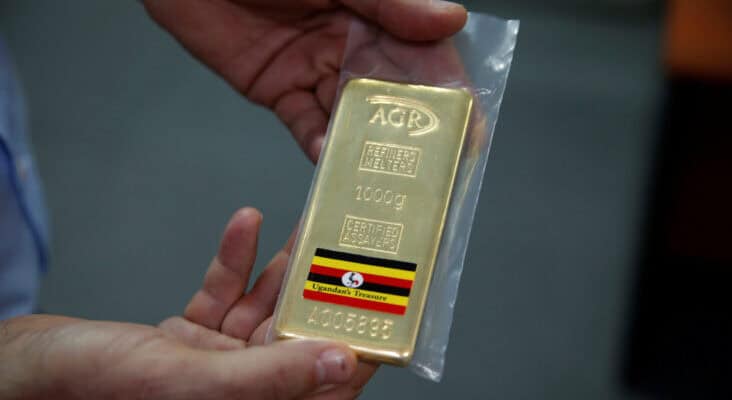
Current Gold Prices in Uganda
Gold prices in Uganda track the international spot benchmark, set in London and New York and quoted in US dollars per troy ounce. Today, the global 24K spot price is approximately $143.16 per gram ($4,453 per troy ounce). Local Ugandan prices typically carry a small premium over this benchmark to cover assay, handling, and logistics costs.
| Weight | Price (USD) |
|---|---|
| 1 Gram | $143 – $147 |
| 5 Grams | $716 – $735 |
| 10 Grams | $1,432 – $1,470 |
| 20 Grams | $2,863 – $2,940 |
| 50 Grams | $7,158 – $7,350 |
| 100 Grams | $14,316 – $14,700 |
| 1 Ounce (31.1g) | $4,453 – $4,570 |
| 250 Grams | $35,790 – $36,750 |
| 500 Grams | $71,580 – $73,500 |
| 1 Kilogram | $143,160 – $147,000 |
By purity, per gram: 24K ≈ $143.16 · 22K ≈ $131.18 · 18K ≈ $107.37
These figures are indicative, move with the live international spot price throughout the day, and should always be confirmed against a current quote before any transaction — ask us for a live quote benchmarked to that day’s spot price rather than relying on a static table.
What Factors Affect Gold Prices in Uganda?
Local prices are driven by the global spot rate, the USD/UGX exchange rate, local mining supply from artisanal and industrial sources, and regional demand. Political stability, government tax policy, and international investor sentiment all feed into short-term price movements, which is exactly why any dealer quoting a fixed, flat price regardless of that day’s spot rate should prompt real questions rather than confidence.
How Does Uganda’s Gold Price Compare to Kenya and Tanzania?
Regional prices are broadly comparable, since all three countries reference the same international benchmark. Kenya’s prices tend to run slightly higher due to demand and tax structure, while Tanzania’s larger-scale mining output sometimes results in marginally lower domestic prices.
What Are Uganda’s Actual Gold Export Procedures and Tax Rates?
Exporting gold from Uganda legally requires purchase from a licensed dealer (a valid MDL is the starting point for any legitimate export chain), assay certification at an approved laboratory such as DGSM’s own facility, an export permit application to DGSM including proof of purchase, the assay certificate, and completed export forms, and customs clearance through the Uganda Revenue Authority once DGSM issues the permit.
It’s genuinely important to get the actual tax structure right here, since this is an area where outdated figures circulate widely: under the Mining and Minerals (Export Levy on Refined Gold) Regulations, 2023, refined gold (99.9%+ purity) carries a flat export levy of $200 per kilogram — not a percentage rate.
This flat structure means the levy’s proportional burden has genuinely shrunk as gold prices have climbed toward and past today’s elevated levels, now representing well under 0.2% of shipment value at current spot.
Unrefined gold, by contrast, carries a 5% ad valorem levy on declared value — a deliberate policy design intended to push more of Uganda’s gold through local refining before it leaves the country.
Additional smaller costs include assay and certification fees (modest, volume-dependent) and, for buyers importing minerals into Uganda specifically, an import permit fee combining a fixed application charge with a percentage of market value.
How Do You Verify a Licensed Gold Dealer in Uganda?
Before buying from any gold seller in Uganda, including us: request the company’s registered name and MDL number, and confirm they match exactly. Check the license against DGSM’s active Mineral Dealer and Refining Licences list directly through official government channels.
Cross-check the registered address with the Uganda Registration Services Bureau. Require an independent assay certificate for the specific consignment, not one supplied only by the seller.
Never wire funds to a personal account, and treat any price significantly below that day’s spot benchmark as a red flag rather than a bargain.
Buying Direct From Artisanal Miners: Risks and How We Manage Them
Buying gold directly from artisanal miners can mean better pricing and direct support for mining communities, but it also carries real risk: unverified purity, missing documentation, and possible non-compliance with export law.
We work with artisanal miners specifically to help formalize sourcing — testing all gold through certified assay and handling the documentation and compliance work — so buyers get artisanal-sourced gold without taking on that risk themselves.
What Gold Investment Options Are Available in Uganda?
Gold bars and bullion offer high liquidity, guaranteed purity with assay certification, and straightforward storage.
Raw or unrefined gold typically costs less but requires its own independent assay verification before any transaction.
Gold coins offer strong liquidity and portability, with the same verification requirements applying regardless of format.
Whatever the format, request the assay certificate and confirm the license before paying — the format itself doesn’t change the verification steps above.
Understanding Gold Purity: 24K, 22K, and 18K Explained
Karat measures how much of a gold item is pure gold, out of 24 parts — this matters enormously when you buy gold in Uganda, since purity is the single biggest driver of price after weight itself.
24K (99.9% pure) is the purest tradable form, standard for gold bars and bullion sold for investment, though genuinely softer and more easily marked than lower-karat gold.
22K (91.7% pure) is common in jewelry and some bullion coins across East Africa, with the remaining 8.3% typically copper or silver alloy added for durability. 18K (75% pure) is mostly a jewelry standard, rarely used for investment-grade bars specifically.
A gold dealer who cannot state the exact karat of the gold on offer, or who quotes a single price regardless of purity, isn’t giving you enough information to value the gold correctly — always ask for the karat and the corresponding assay certificate before agreeing on price.
Uganda’s Gold Mining Regions
Karamoja is Uganda’s most active artisanal and small-scale mining region, particularly around Amudat, Moroto, and Nakapiripirit. Much of Uganda’s raw gold originates here, produced by artisanal miners working alluvial and hard-rock deposits.
Mubende is home to some of Uganda’s more established gold workings, including areas that have attracted both artisanal miners and larger exploration interest over the past decade.
Buhweju is a smaller but genuinely long-standing gold-producing area in western Uganda, historically mined on a small scale.
Gold sourced from artisanal miners in these regions carries more variability in documentation than gold from licensed industrial operations — exactly why the assay-and-documentation step covered throughout this guide is non-negotiable regardless of where the gold originates.
How Is Gold Purity Actually Verified? The Assay Process
An assay is an independent laboratory test confirming two things: the purity (karat/fineness) of the gold, and its exact weight. In Uganda, assaying is typically carried out at DGSM’s own laboratory or another government-approved facility.
The process generally involves sampling — a small representative portion taken for testing, though bars and bullion may undergo non-destructive testing instead — followed by fire assay or XRF testing, with fire assay the traditional, most accurate method for determining gold content by weight, and XRF faster and non-destructive, commonly used for a first-pass check. The lab then issues a signed certificate of analysis stating purity, weight, and testing date.
This certificate is genuinely the single most important document in any Ugandan gold transaction. It should always come from an independent lab, not be printed or supplied by the seller themselves — a “certificate” from the dealer selling you the gold is not independent verification, regardless of how official it looks.
Documentation Checklist Before You Pay
Before finalizing any gold purchase in Uganda, you should have, in hand or verified independently:
- The seller’s Mineral Dealer’s Licence number, confirmed current for the year
- The seller’s registered company name, matching the licence exactly
- An independent assay certificate for the specific gold on offer
- A signed sales agreement stating quantity, purity, price, and delivery terms
- A payment receipt through a traceable channel
- Export permit documentation, if the gold is leaving Uganda
- A certificate of origin, if required by the destination country
How Should You Store and Insure Gold in Uganda?
A bank safe deposit box is widely used and low cost, but check whether your bank’s standard coverage actually extends to bullion, since many don’t insure box contents by default.
A licensed bullion vault offers purpose-built storage, typically insured as part of the service, and is often used by larger investors specifically.
A home safe is only appropriate with a safe rated for the value stored and a specific insurance rider, since standard home insurance policies frequently exclude or cap precious metals coverage.
Keep your assay certificate and purchase documentation together with the gold itself, or in a separate secure location you can access quickly — reselling or insuring gold without its documentation is genuinely far harder and typically reduces its value.

What Should International Buyers Know Before Purchasing?
If you’re purchasing gold in Uganda for import into another country, verification obligations run in both directions. Confirm your own country’s import requirements for gold bullion or raw gold, including any licensing, declaration, or anti-money-laundering documentation your customs authority requires.
Where applicable, an ICGLR certificate may be required for minerals sourced from the Great Lakes region, supporting regional conflict-minerals traceability.
Confirm whether your destination country requires the assay certificate to be issued or countersigned by a specific accredited body, and factor logistics, insurance in transit, and destination-country duties into your total cost — the price in Uganda before shipping is not your final landed cost.
FAQs -Buy Gold in Uganda
Is it legal to buy gold in Uganda? Yes, provided the transaction goes through a licensed dealer and is properly documented, following the step-by-step process covered above.
What is the best place to buy gold in Uganda? Licensed dealers, established markets in Kampala’s central business district, and authorized refineries are the recognized channels. Always verify licensing regardless of the venue.
Can I buy gold in Uganda online? Yes, but verify the seller’s credentials independently before paying anything, exactly as you would for an in-person purchase.
How much does a kilogram of 24K gold cost in Uganda right now? Based on today’s international spot price of approximately $143.16 per gram, a kilogram of 24K gold benchmarks to approximately $143,160, before any dealer premium — always ask for that day’s live quote rather than relying on a static figure, since spot price moves continuously.
Where is gold mined in Uganda? Primarily in Karamoja, Mubende, and Buhweju.
How do I start a gold trading business in Uganda? Register with the relevant authorities, obtain a Mineral Dealer’s Licence from the Ministry of Energy and Mineral Development, and set up compliant export, assay, and payment processes. Contact us if you’d like guidance on this process.
What’s the difference between buying gold bars and raw or unrefined gold? Gold bars and bullion are already refined and typically sold with an assay certificate confirming purity, making them easier to value and resell. Raw or unrefined gold from artisanal sources can be less expensive but requires its own independent assay before you can be confident of its purity or weight.
Do I need a license to buy gold in Uganda for personal investment? Individuals buying gold for personal investment generally don’t need a dealer’s licence themselves — that requirement applies to the seller. If you intend to resell, trade, or export gold commercially, you’d need to register and obtain the relevant licence yourself.
How long does it take to get an export permit in Uganda? Timelines vary by consignment size and DGSM’s processing queue, but budget for the assay, application, and customs clearance steps to take genuinely longer than a single-day transaction — plan export shipments in advance rather than assuming same-day turnaround.
What happens if gold is seized at export without proper documentation? Gold moved without a valid export permit, assay certificate, or proof of levy payment can be seized by Uganda Revenue Authority customs, with the exporter facing legal penalties under the Mining and Minerals Act, 2022. This is exactly why completing every step of the documentation checklist above matters before attempting to move gold across the border.
Can gold prices in Uganda differ from the international spot price? Yes — local prices are typically quoted at a small premium or discount to the international benchmark, reflecting assay, handling, logistics, and dealer costs. A large deviation from spot in either direction, especially a price well below spot, is a signal to slow down and verify rather than a straightforward bargain.
Glossary of Key Terms
Assay — Independent laboratory testing to determine the purity and weight of gold.
DGSM — Directorate of Geological Survey and Mines, the Ugandan government body regulating mineral licensing.
Fineness — The purity of gold expressed as parts per thousand (999 fineness = 99.9% pure).
ICGLR Certificate — A regional certification scheme for minerals sourced from the Great Lakes region, supporting conflict-minerals traceability.
Karat (K) — A measure of gold purity out of 24 parts.
MDL — Mineral Dealer’s Licence, required to legally buy or sell minerals, including gold, in Uganda.
Spot Price — The current international market price for immediate delivery of gold, quoted per troy ounce.
Troy Ounce — The standard unit for weighing precious metals, equal to approximately 31.1 grams.
Get a Current Quote for Certified Uganda Gold
Gold prices move throughout the trading day, so any quote should be benchmarked to that day’s spot rate, not a fixed number.
We’ll provide our current-year MDL certificate, a price tied to the live spot rate, and the full assay and export documentation process for your specific order before any payment is discussed.
Browse our guides to where and how to buy gold in Uganda, Uganda’s gold export laws, gold taxes in Uganda, and the Congo, or our gold producing countries in Africa, gold refineries in Africa, and top African countries to buy gold guides for the fuller picture.
Our 22K gold price and UK import duties and taxes guides round out the compliance side for international buyers, and our Tanzania gold export process guide covers a comparable East African framework.
For international buyers, our delivery guides cover Dubai, Switzerland, Canada, Singapore, and the USA, alongside our broader gold bars from Africa and African gold bars for sale collections.
Our guides to gold bar, gold nugget, and raw gold cover the different product forms available, and our gold mining overview covers our own sourcing directly.
Contact us today or explore our FAQs about buying gold in Africa and how to buy gold online safely guides, our full range of services, and learn more about us.
Related Pages
- Where and How to Buy Gold in Uganda
- Uganda Gold Export Laws
- Gold Taxes in Uganda
- Buy Gold in Congo
- Gold Producing Countries in Africa
- Gold Refineries in Africa
- Top African Countries to Buy Gold
- What Is the Price of 22K Gold?
- UK Import Duties and Taxes on Gold
- Tanzania Gold Export Process
- Buy Gold in Nairobi
- Buy Gold and Silver in South Africa
- Gold Bar Price in South Africa
- Buy Gold in Zimbabwe
- Buy Gold Bullion from Mwanza
- Buy Gold from Local Miners
- Buy Gold Online in Switzerland
- Buy Gold Online in Canada
- Buy Gold in Dubai
- Buy Gold Bars from Africa
- African Gold Bars for Sale
- Buy Gold in Uganda from the USA
- Gold Bar
- Gold Nugget
- Raw Gold
- FAQs About Buying Gold in Africa
- How to Buy Gold Online Safely
- About Us
- Contact Us