How to Spot Fake Gold: 8 Proven Tests That Work
The fastest way to spot fake gold: hold a strong magnet to it. Real gold is non-magnetic — if the piece is attracted at all, it contains non-gold metals.
That single test eliminates the majority of fakes in under five seconds. For higher certainty, combine the magnet test with a density check, ceramic scratch test, and hallmark inspection. For high-value purchases, insist on an independent XRF assay before payment.
Here are all eight proven methods — ranked from quickest to most accurate — with exactly what to look for and what each result means.
1. The Magnet Test — Fastest First Check
What to do: Hold a strong neodymium magnet close to the gold item.
What genuine gold does: Nothing. Real gold is completely non-magnetic and will not move toward or be attracted by any magnet.
What fake gold does: Sticks to, or is attracted toward, the magnet. Even slight movement indicates the presence of iron, nickel, steel, or other magnetic metals.
Limitations: Gold-plated items over non-magnetic base metals (such as brass or copper) can pass the magnet test even though they contain minimal actual gold. The magnet test screens out obvious fakes but does not confirm purity.
Verdict: Use as a fast first filter — it takes five seconds and costs nothing.
2. The Hallmark and Stamp Inspection
What to do: Use a magnifying glass (10x loupe) to examine any stamps or engravings on the piece.
What genuine gold shows:
| Stamp | Meaning |
|---|---|
| 999 or 9999 | 24K gold — 99.9% or 99.99% pure |
| 916 | 22K gold — 91.6% pure |
| 875 | 21K gold — 87.5% pure |
| 750 | 18K gold — 75% pure |
| 585 | 14K gold — 58.5% pure |
| 375 | 9K gold — 37.5% pure |
What fake gold shows: Missing hallmarks, blurry or uneven stamps, incorrect purity numbers, or stamps that rub off. Counterfeiters frequently forge hallmarks, so this test is evidence — not proof. A stamp alone does not authenticate gold.
What to check further: For bars, the hallmark should include the refinery name (e.g., PAMP Suisse, Valcambi, Rand Refinery), a serial number, and a weight designation. All three should match the accompanying assay certificate exactly.
Verdict: Essential first visual check — always inspect hallmarks, but never rely on them alone.
3. The Density Test — Most Reliable at Home
What to do: Gold is one of the densest metals on earth, with a density of 19.32 g/cm³. You can calculate the density of any piece using a scale and a container of water:
- Weigh the item dry (in grams) — record as W1
- Suspend the item fully submerged in water on the scale and weigh again — record as W2
- Calculate density: Density = W1 ÷ (W1 − W2)
- Compare to 19.32 g/cm³ for 24K gold
Density reference for common gold purities:
| Karat | Expected Density (g/cm³) |
|---|---|
| 24K (999.9) | 19.32 |
| 22K (916.7) | 17.7–17.8 |
| 18K (750) | 15.5–15.9 |
| 14K (585) | 13.0–14.0 |
What fake gold shows: Significantly lower density. Gold-plated copper reads ~8.9 g/cm³. Gold-plated tungsten reads ~19.25 g/cm³ — very close to real gold, which is why tungsten-core bars are the most dangerous counterfeit. The density test catches most fakes but not tungsten-filled bars.
The float test (simpler version): Drop the item in water. Real gold sinks immediately and does not float. Floating or hovering indicates lighter, less dense metals. However, this is less precise than the full density calculation.
Verdict: Best home test for solid gold. Pair with hallmark inspection and magnet test for strong combined confidence.
4. The Ceramic Scratch Test
What to do: Firmly rub the gold item across a piece of unglazed ceramic tile or porcelain (a ceramic plate turned face down works well).
What genuine gold leaves: A gold-coloured streak.
What fake gold leaves: A black, dark grey, or green streak.
Important caution: This test will leave a visible scratch on the gold surface. Only use it on inconspicuous areas of jewellery, or on scrap gold, not on collector coins or hallmarked bars where surface integrity matters.
Verdict: Useful for rings, chains, and jewellery. Not recommended for investment bars or numismatic coins where surface damage reduces value.
5. The Nitric Acid Test
What to do: Apply a small drop of nitric acid (available in gold testing kits) to the surface of the item — ideally on a scratch or inconspicuous area.
What genuine gold does: Shows no reaction. Real gold is chemically inert and does not react to nitric acid.
What fake gold does:
- Gold-plated copper or brass: Turns green immediately
- Gold-plated silver: Turns milky or cream-coloured
- Sterling silver (92.5%): Turns grey/black
- Low-karat gold (below 10K): Turns brown or discolours
Safety requirement: Nitric acid is corrosive and produces harmful fumes. Wear gloves and eye protection. Perform the test only in a well-ventilated area. This test is best performed at a reputable gold dealer or jewellery shop, not at home without proper precautions.
Verdict: Highly accurate for identifying the metal type. Standard practice at professional gold buying offices worldwide.
6. The Electronic Gold Tester
What to do: Apply the probe of an electronic gold tester to the surface of the item. The device measures electrical conductivity, which varies predictably with gold purity.
What genuine gold shows: A reading consistent with the stated karat — 24K, 22K, 18K, etc.
What fake gold shows: A reading inconsistent with the hallmark, or an out-of-range result indicating base metals.
Where to find one: Professional jewellers, gold buying offices, pawnbrokers, and licensed gold dealers all use electronic testers. They are also available for purchase (~$50–$300) for frequent buyers.
Limitations: Electronic testers can be fooled by thick gold plating if the probe does not penetrate to the base metal. XRF analysis is more reliable for definitive purity testing.
Verdict: Fast, accurate, non-destructive. The standard tool for retail gold buying offices.
7. XRF (X-Ray Fluorescence) Testing — Gold Standard for Purity
What to do: An XRF analyser fires X-rays at the gold surface, which causes the metal’s atoms to emit secondary X-rays. The energy of these secondary emissions identifies the exact elemental composition of the gold — providing a precise purity reading (e.g., 99.97% gold, 0.02% silver, 0.01% copper) in 30–60 seconds without damaging the piece.
Why it matters for high-value purchases: XRF testing is the only method that non-destructively detects:
- Precise purity down to 0.01% accuracy
- Tungsten-core bars (if the surface layer is not too thick)
- Plating depth and base metal identification
- Whether a bar matches its stated refinery composition
Where to access XRF testing:
- Licensed gold dealers and refineries (most provide this as a service)
- Independent assay laboratories
- Mint and refinery authorised testing centres
- Cost: typically $50–$200 per item for third-party testing
Verdict: The most reliable non-destructive gold authenticity test available. Mandatory for purchases above $5,000. Insist on it before any significant gold transaction.
8. Professional Appraisal and Fire Assay
What to do: For the highest possible certainty — particularly on large gold bars, significant coin collections, or high-value doré — submit the item to an accredited assay laboratory for fire assay testing.
How fire assay works: A sample of the gold is melted with lead and flux. The resulting bead is weighed, chemically separated, and analysed to determine exact gold content. Fire assay is the definitive legal standard for gold purity — it is the method used in export certification, LBMA Good Delivery testing, and legal disputes.
Cost: Approximately $50–$200 per sample. Results typically take 1–3 business days.
Verdict: The absolute gold standard for purity verification. Required for any export documentation and LBMA Good Delivery certification.
Common Types of Fake Gold — Know What You Are Dealing With
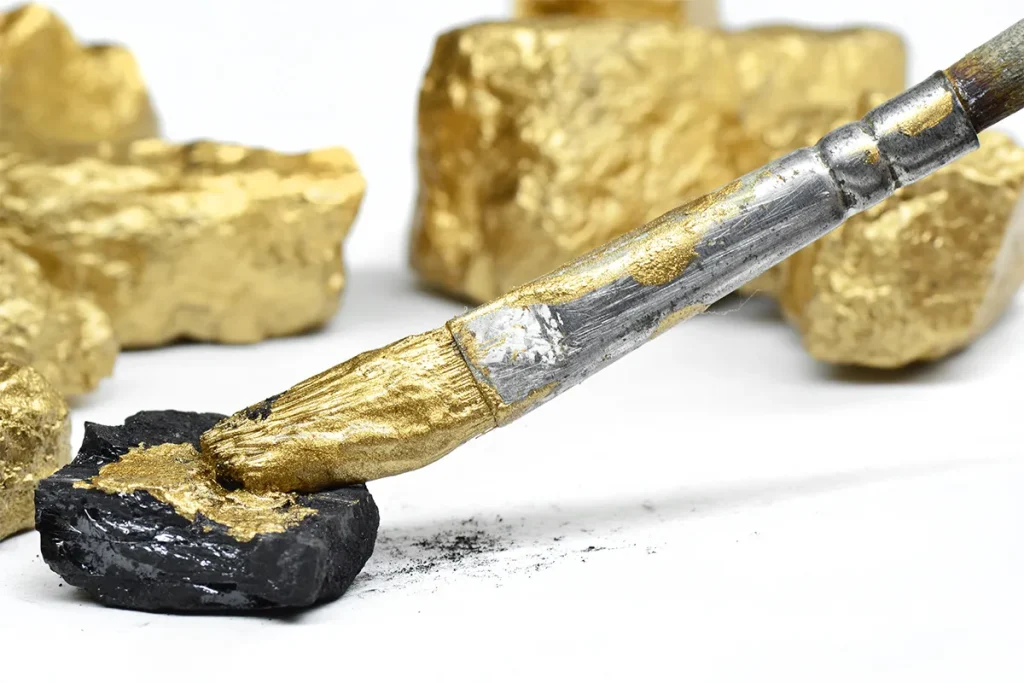
Gold-plated items: A thin layer of real gold (typically 0.5–2.5 microns) electroplated over a base metal core — usually brass, copper, or silver. The most common fake encountered at markets and online. Passes visual inspection and hallmark check. Identified by density test, nitric acid, or electronic tester.
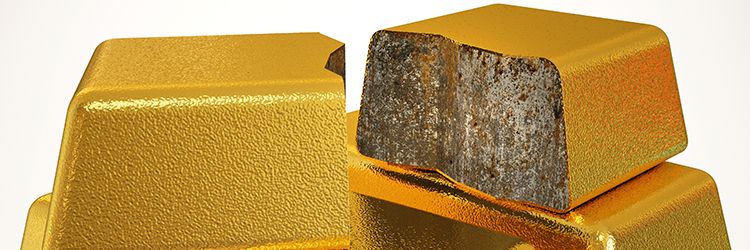
Tungsten-core gold bars: The most dangerous and sophisticated counterfeit. Tungsten has a density of 19.25 g/cm³ — almost identical to gold’s 19.32 g/cm³ — making density tests unreliable. A 1kg bar with a tungsten core can look, feel, and weigh almost identically to a genuine bar. Detected by XRF analysis, ultrasound testing, or drilling (destructive). Always buy bars from LBMA-accredited refineries with serial number verification.
Fake hallmark stamps: Forgeries of reputable refinery hallmarks (PAMP Suisse, Valcambi, Rand Refinery) applied to base metal bars. Increasingly sophisticated. Detected by cross-referencing serial numbers directly with the refinery and XRF purity testing.
Gold-washed or gold-filled jewellery: Contains more gold than plated items but far less than solid gold. A 14K gold-filled piece may contain only 1/20th gold by weight. Identified by density test and acid test on the base metal when the gold layer is scratched through.
Imitation coins and collector pieces: Cast or stamped fakes of sought-after coins (Krugerrands, American Eagles, Maple Leafs). Often lighter and with poorer edge definition than originals. Detected by precise weighing, edge inspection under magnification, and electronic testing.
How to Spot Fake Gold When Buying Online
Online gold purchases carry additional fraud risks because physical inspection is not possible before payment. These are the verification steps that protect you:
Buy only from licensed, verified dealers. Reputable dealers are accredited by relevant national authorities (PMMC in Ghana, TMC in Tanzania, Minerals Commission in South Africa, NEPC in Nigeria). Africa Gold Suppliers Ltd is a licensed, verified gold dealer providing full assay certification, certificate of origin, and independent purity documentation on every order.
Insist on an independent assay certificate. The certificate must be issued by a laboratory that is independent from the seller — not by the seller themselves. The certificate should show the gold’s weight, purity in fineness (e.g., 999.9), and a unique batch or serial number.
Verify bar serial numbers. For LBMA Good Delivery bars and major mint products, the serial number on the bar should match the serial number on the assay certificate — and can be cross-referenced on the refinery’s official database.
Use secure, traceable payment. Bank transfer, SWIFT wire, or letter of credit only. Never pay via Western Union, MoneyGram, cryptocurrency, or cash for gold purchases. Untraceable payments are a scam indicator.
Never pay before documentation is verified. Any dealer requesting advance payment of “customs fees,” “certification costs,” or “insurance” before delivering gold is running an advance-fee fraud. Africa Gold Suppliers Ltd operates on a zero advance-fee basis — documentation is verified before any payment is released.
Fake Gold Red Flags — Quick Reference
| ⚠️ Warning Sign | What It Indicates |
|---|---|
| No hallmark or blurry stamp | Likely base metal or poor plating |
| Attracted to a magnet | Contains iron, steel, or nickel |
| Price 20%+ below current spot | Almost certainly fraudulent |
| Seller refuses independent assay | Gold is not what they claim |
| Advance payment demanded before delivery | Advance-fee fraud |
| No certificate of origin or assay certificate | Cannot verify legal source or purity |
| Green or black discolouration on acid test | Base metal — not real gold |
| Unusual lightness for stated weight | Hollow, plated, or wrong metal |
| Foam or hover when placed in water | Too light — not gold density |
FAQs: How to Spot Fake Gold
What is the most reliable way to spot fake gold at home? Combine three tests: magnet test (non-magnetic), density test (should be ~19.32 g/cm³ for 24K), and hallmark inspection with a loupe. Together, these identify the majority of fakes without specialist equipment.
Can fake gold pass the magnet test? Yes — gold-plated copper, brass, or tungsten items are all non-magnetic. The magnet test only screens out fakes containing iron, steel, or nickel. Always use additional tests.
How do I tell if a gold bar is real? For investment bars: verify the hallmark and serial number under magnification, check the weight against the stated specification, insist on an independent XRF assay certificate, and cross-reference the serial number with the producing refinery’s database. Tungsten-core bars can only be reliably detected by XRF analysis.
Does real gold leave a mark on ceramic? Yes — genuine gold leaves a gold-coloured streak on unglazed ceramic. Fake gold or base metals leave a black or dark grey streak.
How do I spot fake gold jewellery? Inspect hallmarks (916 for 22K, 750 for 18K, 999 for 24K). Perform the magnet test. Look for discolouration at wear points where plating has worn through. For certainty, take the piece to a licensed jeweller for electronic testing or acid test.
What does fake gold look like? Fake gold often looks identical to real gold to the naked eye — that is the point. Warning signs include: slight greenish tint after handling, tarnishing over time (real gold does not tarnish), discolouration at edges or wear points, unusual lightness for the size, and missing or blurry hallmarks.
Is it safe to buy gold from Africa Gold Suppliers Ltd online? Yes. Africa Gold Suppliers Ltd provides independent assay certification, certificate of origin, full export documentation, and insured worldwide delivery on every order. All transactions operate on a zero advance-fee basis — documentation is verified before any funds are released.
Summary: How to Spot Fake Gold — Test by Test
| Test | Time Required | Equipment Needed | Detects | Reliability |
|---|---|---|---|---|
| Magnet test | 5 seconds | Strong magnet | Magnetic metals (iron, steel, nickel) | Good for quick screening |
| Hallmark inspection | 1 minute | 10x loupe | Missing/forged stamps | Good first check |
| Density / float test | 5–10 minutes | Scale, water container | Wrong metal or hollow items | Very good |
| Ceramic scratch test | 1 minute | Unglazed ceramic tile | Base metal vs gold | Good — causes surface damage |
| Nitric acid test | 5 minutes | Gold testing kit, gloves | Metal type precisely | Excellent |
| Electronic gold tester | 1 minute | Electronic tester device | Purity level | Very good |
| XRF analysis | 30–60 seconds | XRF analyser (specialist) | Exact elemental composition | Excellent — non-destructive |
| Fire assay | 1–3 days | Accredited laboratory | Definitive legal purity | Gold standard |
For any gold purchase above $1,000 in value, always insist on at minimum an electronic tester reading and an independent assay certificate. For purchases above $5,000, XRF analysis is non-negotiable.