How to Verify a Gold Dealer’s Licence Before Making Payment
How to Verify a Gold Dealer’s Licence: To verify a gold dealer’s licence before making payment, obtain the seller’s registered business name and licence number, identify the government authority that issued the licence, and check its validity directly through that authority’s official registry or licensing office.
Confirm that the licence covers gold trading and the specific activity being offered, whether purchasing, selling, processing or exporting gold.
A company registration certificate, business website, tax identification number or photograph of a mineral licence does not automatically prove that a business is authorised to trade or export gold. The licence must be genuine, current and issued to the same legal entity receiving your payment.
This verification is particularly important when buying gold from Africa because mineral trading laws differ between countries. A broker may be permitted to purchase and resell gold locally but prohibited from exporting it. Similarly, a mining licence does not automatically authorise its holder to operate as a mineral dealer or gold exporter.
International buyers should verify the dealer’s identity, licensing category, permitted activities, licence expiry date and applicable export permissions before signing an agreement or transferring money.
The Complete Process for Verifying a Gold Dealer’s Licence Before Making Payment
1. Request the Gold Dealer’s Official Licence Details
The first step is requesting the seller’s complete licence information before discussing payment arrangements.
A legitimate gold dealer should be able to identify the government authority responsible for licensing its business and provide the relevant documentation for verification.
Request the following information:
- Registered company name: The exact legal name appearing on the company’s incorporation documents.
- Mineral dealer licence number: The unique number assigned by the relevant mining or mineral authority.
- Licence category: Whether the business holds a dealer, broker, buyer, exporter, refiner or another relevant authorisation.
- Issuing authority: The government agency responsible for granting the licence.
- Issue and expiry dates: The dates establishing when the licence was granted and when it must be renewed.
- Registered business address: The location associated with the licensed company.
- Authorised mineral types: Confirmation that the licence covers gold or the relevant precious-metal category.
- Permitted activities: Whether the company can purchase, sell, possess, process or export gold.
Ask for a clear copy of the licence, preferably the complete document rather than a cropped photograph showing only its number.
The seller should also provide its company registration details so you can compare the legal entity appearing on the business registration and mineral licence.
Important: Do not rely on a WhatsApp image, PDF attachment or business card as proof of licensing. These documents can be copied, altered or issued in the name of another company. The information must be checked independently with the issuing authority.
2. Identify Which Government Authority Issued the Licence
Gold trading is regulated at national level, and each African country has its own licensing authorities and legal requirements.
You should establish which government agency is responsible for regulating the particular gold transaction before attempting to verify a licence.
For example:
| Country | Relevant licensing authority or system | What to verify |
|---|---|---|
| Uganda | Directorate of Geological Survey and Mines (DGSM) | Mineral dealer and refining licence status |
| Ghana | Ghana Gold Board (GoldBod) | Licensed business name, licence number and category |
| Tanzania | Tanzania Mining Commission (TMC) | Broker or dealer licence and permitted activities |
| Kenya | State Department for Mining and Mining Cadastre Portal | Mineral dealing licence or permit |
| South Africa | South African Diamond and Precious Metals Regulator (SADPMR) | Precious-metals dealer certificates and relevant licences |
Do not assume that a licence issued by one country authorises a business to trade or export gold from another country.
For example, a Ugandan mineral dealer licence does not automatically grant the holder a Tanzanian dealer licence. Similarly, a company registered in Kenya cannot automatically export gold simply because it has a general business registration certificate.
3. Verify the Licence Through the Official Government Registry
After obtaining the licence number, visit the relevant government’s official website and look for its mineral licensing register, dealer database or public mining cadastre.
Use the official website independently rather than relying exclusively on a verification link supplied by the seller.
Search using the company’s registered legal name and licence number.
Check that:
- The registered business name matches the licence.
- The licence number is identical to the document supplied.
- The issuing authority is correct.
- The licence has not expired.
- The licence status is active, where a status field is provided.
- The licence covers gold or precious metals.
- The authorised activities match the seller’s claims.
Some regulators provide searchable online databases, while others require buyers to contact the licensing department directly.
Where a complete public register is unavailable, request written confirmation from the issuing authority using contact information published on its official website.
A screenshot of a search result is useful for recordkeeping, but it should not replace direct verification of the current licence status.
4. Check Whether the Licence Covers Gold Trading
One of the most common mistakes made by international buyers is assuming that every mining or mineral-related licence allows its holder to purchase and sell gold.
Different licences authorise different business activities.
For example:
Mining licence: Authorises the holder to conduct specified mining activities within the licensed area, subject to its conditions.
Mineral dealer licence: Authorises specified mineral trading activities.
Mineral broker licence: May permit an intermediary to purchase or sell minerals within designated channels, but may restrict exporting.
Mineral processing licence: Authorises specified processing activities.
Mineral refining licence: Authorises the holder to refine qualifying mineral materials under the applicable rules.
Gold export permit: Authorises the export of a particular consignment when issued under the relevant national procedures.
A company holding a mineral processing licence should not automatically be considered an authorised gold dealer.
Likewise, a mining company cannot assume that its mining licence grants every possible commercial trading and export right.
Buyers should ask the seller to explain precisely which authorisation permits the proposed transaction.
5. Confirm That the Licence Is Still Valid
A gold dealer may provide a genuine licence that has already expired or has not been renewed.
Always compare the issue date, expiry date and current licence status before proceeding.
Check whether:
- The licence is valid on the proposed transaction date.
- Annual renewal has been completed where required.
- The company name has remained unchanged or any legal name changes have been recognised.
- The licence has been suspended, cancelled or replaced.
- The licence category still covers the proposed activity.
Different countries have different renewal periods.
For example, Uganda’s DGSM Mining Cadastre Portal states that a Mineral Dealer’s Licence expires on 31 December of the year in which it is issued. Tanzania’s Mining Commission describes broker and dealer licences as valid for 12 months, running from 1 July to 30 June.
Never assume that a licence remains valid simply because the seller obtained it several years ago.
6. Verify the Company Behind the Licence
Verifying a mineral dealer licence is only part of the process. You should also establish whether the business presenting the licence is the actual legal entity that will enter into the sales agreement and receive payment.
Request the company’s:
- Certificate of incorporation or business registration.
- Registered company name and registration number.
- Registered business address.
- Directors and authorised representatives.
- Tax identification information, where relevant.
- Current mineral dealer licence.
- Official company email address and telephone number.
Compare this information against the licence, invoice, proforma invoice and sales agreement.
For example, if a company provides a mineral dealer licence in the name of Company A but asks you to sign an agreement with Company B and transfer funds to an individual, you should establish the legal relationship between these parties before paying.
A registered business does not automatically hold permission to trade in gold. Company registration and mineral licensing are two separate requirements.
7. Verify the Person Representing the Gold Dealer
International buyers often communicate with sales agents, brokers, consultants and company representatives rather than the directors of the licensed business.
You should establish whether the individual negotiating the transaction is authorised to act for the company.
Request:
- The representative’s full legal name.
- Their official company position.
- A company email address.
- Written authority to represent the licensed business.
- Confirmation from the company’s registered contact details.
If an agent claims to be negotiating on behalf of a licensed gold dealer, contact the company directly using its independently verified telephone number or email address.
Do not send money to a representative merely because they have shared a photograph of the company’s licence or introduced you to a supposed government official.
8. Check Whether the Licence Permits Gold Export
A local gold trading licence does not necessarily authorise international exports.
This is particularly important because some African countries distinguish between licences that allow local mineral dealing and those that permit exports.
Before purchasing gold for international delivery, confirm:
- Whether the seller is authorised to export gold.
- Whether a separate export permit is required.
- Whether the exporter holds the relevant dealer or mineral-right authorisation.
- Whether the gold must undergo processing or refining before export.
- Whether source-country documents are available.
- Whether the export permit is issued for the actual shipment.
A gold dealer may be legally permitted to purchase gold locally but still need another authorisation to export it.
An export permit is also different from a dealer licence. In some countries, the dealer licence is a continuing business authorisation, while an export permit is issued for an individual consignment.
For further information, read our guide to exporting gold bullion from Africa.
9. Compare the Licence With the Payment and Sales Documents
Before transferring money, compare the licensed company’s details with the information appearing on the financial and contractual documents.
The following details should be consistent:
| Document | What to compare |
|---|---|
| Mineral dealer licence | Legal company name and licence number |
| Company registration certificate | Legal entity and registration number |
| Proforma invoice | Seller identity and product details |
| Sales and Purchase Agreement | Contracting seller and authorised signatory |
| Bank account information | Beneficiary name and contracting entity |
| Commercial invoice | Seller, buyer, gold description and transaction details |
| Export permit | Exporting entity, shipment and applicable gold product |
| Certificate of origin | Declared gold origin |
| Assay certificate | Gold purity, sample and batch identification |
Where a payment is made through a third-party arrangement, the legal reason and contractual relationship should be documented and independently checked.
Do not transfer substantial funds to a personal bank account simply because a representative says the licensed company cannot receive international payments.
10. Verify the Gold Separately From the Dealer’s Licence
A valid dealer licence does not establish that the gold being offered is genuine, correctly assayed or legally sourced.
Licence verification and gold verification are two separate checks.
Once the seller’s licensing status has been established, investigate the specific gold consignment.
Request:
- An independent assay certificate.
- The gold’s weight and purity.
- The actual batch or bar identification.
- Relevant mine or supplier records.
- Chain-of-custody documentation.
- A certificate of origin, where applicable.
- The applicable purchase and export records.
For refined bullion bars, compare the serial number and fineness markings with the relevant product and assay documentation.
For gold doré, nuggets and dust, arrange representative sampling and independent testing before finalising the agreed value.
Explore our guide to buying genuine gold and identifying real gold for additional verification methods.
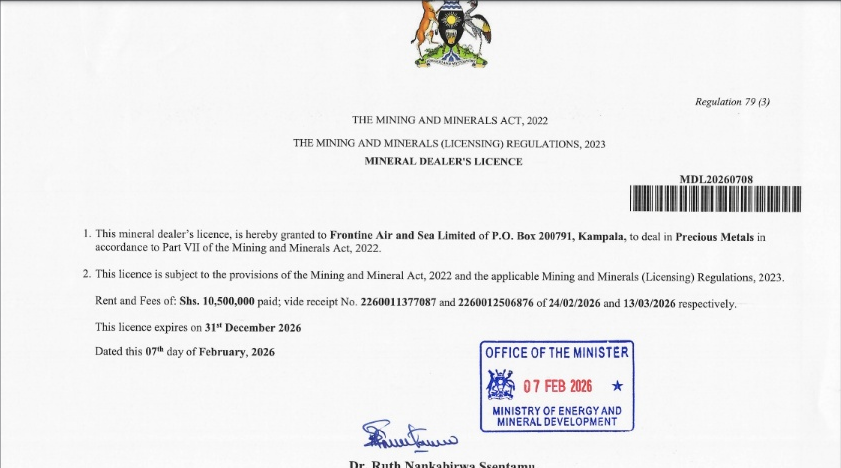
How to Verify a Gold Dealer’s Licence in Uganda
Uganda’s Directorate of Geological Survey and Mines (DGSM), under the Ministry of Energy and Mineral Development, operates the Uganda Mining Cadastre Portal.
The portal provides information about mineral rights, mineral dealer licences and refining licences.
It also publishes a list of active mineral dealer and refining licences, which is updated weekly.
To verify a Ugandan gold dealer:
- Request the company’s registered name and Mineral Dealer’s Licence (MDL) number.
- Visit the official Uganda Mining Cadastre Portal.
- Open the public list of active mineral dealer and refining licences.
- Search for the company’s registered name or licence number.
- Compare the licence details with the document supplied by the seller.
- Check that gold is included under the precious-metals category.
- Confirm the licence’s current validity.
- Contact DGSM if the information is missing, unclear or inconsistent.
Official verification resources:
The DGSM portal distinguishes between mineral dealer, processing, smelting and refining licences. It also states that gold export permits are granted per consignment and require the relevant supporting documents.
For gold exports from Uganda, the portal identifies requirements including a valid Mineral Dealer’s Licence or Mineral Right, the relevant export permit application, applicable royalty payment evidence, certificate of origin and certificate of analysis where required.
Buyers should therefore verify the dealer licence separately from the export permit for the specific shipment.
For additional information, see our guide to buying gold in Uganda.
How to Verify a Gold Dealer’s Licence in Ghana
Ghana’s gold trading framework is administered by the Ghana Gold Board (GoldBod).
GoldBod is responsible for licensing persons and businesses engaged in gold trading and related activities covered by its regulatory framework.
Its official licence categories include:
- Aggregator licence.
- Self-financing aggregator licence.
- Buyer licence, Tier 1.
- Buyer licence, Tier 2.
- Refinery licence.
- Jewellery and fabrication licences.
These categories authorise different activities. A business holding one category should not automatically be assumed to have permission to undertake every other gold-related activity.
To verify a Ghanaian gold dealer:
- Obtain the exact registered business name.
- Request its GoldBod licence certificate number.
- Visit the official GoldBod Licence Registry.
- Search for the registered company name or licence number.
- Compare the issue and expiry dates.
- Check the licence category.
- Confirm that the proposed transaction falls within the authorised activity.
The registry displays registered business names, licence certificate numbers and issue and expiry dates.
Important: Ghana’s current gold-trading system has specific restrictions on foreign participation. International buyers should not assume they can purchase artisanal and small-scale mining gold directly from individual miners or local brokers. They must follow the applicable GoldBod-approved arrangements.
For a detailed country-specific explanation, read How to Verify Ghana Gold.
How to Verify a Gold Dealer’s Licence in Tanzania
The Tanzania Mining Commission (TMC) administers mineral trading and licensing in Tanzania.
Tanzania distinguishes between mineral broker licences and mineral dealer licences. This distinction is particularly important for international gold buyers.
Broker Licence
A broker licence allows its holder to purchase minerals through the buying stations specified in the licence and sell them to licensed dealers through the designated mineral trading channels.
A broker licence does not authorise its holder to export minerals from Tanzania.
Dealer Licence
A dealer licence authorises specified mineral dealing activities and can allow the holder to export minerals, subject to the applicable export permit and other legal requirements.
To verify a Tanzanian gold dealer:
- Request the company’s registered name.
- Obtain the mineral dealer or broker licence number.
- Check which minerals are covered.
- Establish whether the licence is current.
- Verify whether the seller is a broker or dealer.
- Confirm the relevant permitted activities.
- Establish whether the seller is authorised to export the gold.
The Tanzania Mining Commission states that broker and dealer licences are valid for 12 months, running from 1 July to 30 June of the following year.
Use the official Tanzania Mining Commission Licensing Services to understand the different licence categories.
For an international purchase, also review the Commission’s mineral export procedures.
How to Verify a Gold Dealer’s Licence in Kenya
Kenya’s State Department for Mining requires businesses engaging in mineral dealing to hold the appropriate mineral dealing licence or permit.
The government operates an online Mining Cadastre Portal for mineral rights and dealer licensing.
To verify a Kenyan gold dealer:
- Request the registered company name and licence or permit number.
- Visit the official Kenya Mining Cadastre Portal.
- Check the licence information through the appropriate portal service.
- Confirm that the authorisation covers the precious-metals category.
- Check the licence or permit’s validity.
- Establish whether the authorisation permits domestic trading or export.
An important distinction in Kenya is that a mineral dealing permit allows mineral business within Kenya but is not eligible for exports. International buyers should confirm that the seller holds the appropriate dealing licence and export approvals for the transaction.
Official guidance is available through the Kenya State Department for Mining.
How to Verify a Gold Dealer’s Licence in South Africa
South Africa regulates precious-metal transactions through the South African Diamond and Precious Metals Regulator (SADPMR).
The Precious Metals Act 2005 establishes restrictions relating to the acquisition, possession and disposal of unwrought precious metals.
Depending on the activity, the regulator administers:
- Refining licences.
- Precious-metal beneficiation licences.
- Jeweller’s permits.
- Special permits.
- Certificates authorising the buying or selling of precious metals.
A company involved in gold refining does not automatically hold the same authorisation as a business buying or selling unwrought gold.
To verify a South African gold supplier:
- Identify the company’s legal name.
- Request the relevant SADPMR certificate, permit or licence.
- Establish which precious-metal activity the document authorises.
- Check the document with SADPMR.
- Confirm whether the seller is permitted to acquire, possess or dispose of the particular gold product.
- Separately verify any export approval required for the shipment.
Visit the South African Diamond and Precious Metals Regulator and its precious-metals regulations page.
What Documents Should You Request Before Paying a Gold Dealer?
A gold dealer’s licence is a starting point, not the complete documentation required for a safe transaction.
Before payment, request the relevant documents for the supplier, transaction and gold consignment.
| Document | What it establishes |
|---|---|
| Company registration certificate | Identifies the legal business |
| Mineral dealer licence or applicable certificate | Supports the authority to conduct specified mineral activities |
| Licence verification or regulator confirmation | Helps establish whether the licence is genuine and current |
| Sales and Purchase Agreement | Records the terms agreed by buyer and seller |
| Proforma invoice | States the products, quantity, pricing and payment terms |
| Assay certificate | Reports the tested gold purity |
| Certificate of origin | Supports the declared country of origin |
| Chain-of-custody records | Documents how the gold moved through the supply chain |
| Export permit | Authorises the relevant shipment where required |
| Customs documentation | Records the export or import declaration |
| Air waybill or transport document | Records shipment details |
| Insurance documentation | Establishes the applicable cargo insurance |
Not every transaction requires exactly the same documents. Requirements depend on the source country, the type of gold, the business activity and the destination country.
For a comprehensive document checklist, read our Gold Export Documents Checklist and Certificate of Origin for Gold.
Warning Signs of a Fake or Unlicensed Gold Dealer
A seller’s inability or unwillingness to allow independent licence verification should be taken seriously.
Watch for the following warning signs before making payment.
1. The Seller Refuses to Provide a Licence Number
A seller who claims to be licensed but will not disclose the relevant licence number makes independent verification difficult.
2. The Licence Belongs to Another Company
A document bearing a different business name should not be accepted without establishing the legal relationship between the parties and confirming the authority to transact.
3. The Licence Has Expired
An old licence is not proof of current authorisation. Check the latest issue and expiry dates.
4. The Licence Does Not Cover Gold
A general business registration, mining permit or licence for another mineral does not automatically authorise gold trading.
5. A Broker Claims to Be an Exporter
This is particularly important in Tanzania and other jurisdictions where brokers and exporters have different permissions.
6. The Seller Provides Only a Screenshot
Screenshots can be edited or taken from outdated records. Search the official register independently.
7. The Payment Account Does Not Match the Seller
A seller asking for payment to an unrelated individual’s bank account should provide a clear, independently verifiable explanation before any funds are sent.
8. The Seller Pressures You to Pay Immediately
Legitimate businesses should allow reasonable time for licence checks, document review and independent testing.
9. The Seller Promises Gold at an Implausibly Low Price
An unusually low offer, particularly one below the fine-gold market value, requires a clear and verifiable commercial explanation. It may indicate misrepresented purity, undocumented material or fraud.
10. The Seller Cannot Explain the Export Process
A supplier intending to export gold should understand the licensing, consignment permits, customs documents and other requirements applicable to the shipment.
Read our Gold Smuggling in Africa article and Buying Genuine Gold: How to Identify Real Gold and Avoid Scams for further fraud-prevention guidance.
What to Do If a Gold Dealer’s Licence Cannot Be Verified
Do not make payment while a material licensing concern remains unresolved.
Take the following steps:
- Request a clearer copy of the licence and the company’s exact registered name.
- Check the licence number through the official government registry.
- Contact the issuing authority using contact details from its official website.
- Ask whether the licence is genuine, current and valid for the proposed activity.
- Request written confirmation if the public registry does not provide enough information.
- Check whether the export permissions are separate from the trading licence.
- Keep copies of the licence, emails, invoices and verification results.
- Walk away if the seller refuses independent verification or provides conflicting information.
A legitimate company should not object to a buyer checking its authorisation before committing funds.
How Africa Gold Suppliers Ltd Approaches Gold Dealer Verification
Africa Gold Suppliers Ltd is based in Kampala, Uganda, and supplies refined gold bars to international buyers through documented sourcing and export arrangements.
The company states that it works with licensed miners and dealers in Uganda and the wider East African region and encourages customers to independently verify its company and mineral licensing documents before making a purchase.
For buyers considering a transaction with Africa Gold Suppliers Ltd, the appropriate checks include:
- Request the company’s current Ugandan Mineral Dealer’s Licence details.
- Check the legal company name against the DGSM public register.
- Confirm the licence covers the precious-metals category.
- Establish whether the proposed transaction involves Ugandan-origin or other African-origin gold.
- Review the source and chain-of-custody records.
- Request the independent assay report for the gold being offered.
- Verify the export permit and supporting documentation for the actual shipment.
- Confirm that the contracting business and payment beneficiary match.
The company also provides information about its gold sourcing and refining services, gold bars for sale and gold supply from local miners.
You can learn more about the company’s operations on the Africa Gold Suppliers About page or contact the company to request its current documentation.
Gold Dealer Licence Verification Checklist Before Payment
Use this checklist before sending money to a gold dealer in any African country.
-
Obtain the seller’s full registered business name.
-
Obtain the mineral dealer licence or relevant authorisation number.
-
Identify the government authority that issued it.
-
Check the licence through the official government registry.
-
Confirm that the registered name matches the legal seller.
-
Confirm that the licence is current and has not expired.
-
Check that it covers gold or precious metals.
-
Establish whether it permits buying, selling, refining or exporting.
-
Verify that the person negotiating the sale is authorised.
-
Compare the licence details with the sales agreement and invoice.
-
Confirm that the payment beneficiary matches the contracting business.
-
Verify the gold’s source and chain-of-custody records.
-
Obtain and independently check the assay certificate.
-
Confirm the export permit and other shipment documents where required.
-
Review the delivery, insurance and payment conditions.
Do not proceed with payment until the required checks have been completed.

FAQs About Verifying Gold Dealer Licences
How can I check whether a gold dealer is licensed?
Request the dealer’s legal company name and licence number. Identify the relevant government mining or mineral-trading authority and search its official licence registry. Check the licence status, expiry date, mineral category and authorised activities.
Can I verify a gold dealer’s licence online?
Yes, in several African countries. Uganda has a public DGSM Mining Cadastre Portal, Ghana has the GoldBod Licence Registry, and Kenya operates an online Mining Cadastre Portal. Other authorities may require direct written or telephone verification.
Is a company registration certificate enough to prove that a gold dealer is licensed?
No. Company registration confirms the existence of a legal business entity. It does not automatically authorise the company to buy, sell, refine or export gold. The relevant mineral trading authorisation must also be verified.
What is the difference between a gold dealer licence and an export permit?
A gold dealer licence authorises specified mineral trading activities over its validity period. An export permit authorises a particular consignment to leave the country under the relevant procedures. Some jurisdictions require both.
Can a gold broker legally export gold?
It depends on the country’s legislation. In Tanzania, a broker licence does not authorise the holder to export minerals. A dealer licence is required for the applicable dealer export activities, together with the relevant export permit.
How do I verify a Ugandan gold dealer’s licence?
Use the DGSM Mining Cadastre Portal and its public list of active mineral dealer and refining licences. Search for the seller’s registered name or licence number and compare the details with the licence supplied.
How do I verify a Ghanaian gold dealer’s licence?
Use the official Ghana Gold Board Licence Registry. Search the registered business name or licence certificate number, then check its licence category, issue date and expiry date.
How do I check a Tanzanian gold dealer’s licence?
Request the broker or dealer licence number and verify it through the Tanzania Mining Commission. Confirm the licence category and whether the business is authorised to export the proposed gold.
What if a dealer’s licence does not appear on the official registry?
Pause the transaction and contact the issuing authority directly. Ask for written confirmation of the licence’s current status and scope. Do not rely on the seller’s explanation alone.
Does a gold dealer licence prove that the gold is genuine?
No. A dealer licence establishes certain legal permissions. It does not prove that a particular gold bar, nugget or doré consignment is genuine or has the declared purity. Independent assay and product verification are separate requirements.
Should I pay a gold dealer before verifying their licence?
No. Verify the business identity, relevant licence and authorised activities before transferring funds. You should also review the sales agreement, payment beneficiary and gold documentation.
Is it safe to buy gold from an online African dealer?
It can be, provided the buyer independently verifies the supplier’s legal identity and licensing, checks the gold’s purity and origin, reviews the relevant export documents and uses an appropriate traceable payment arrangement.
Conclusion: Verify the Gold Dealer’s Licence Before Sending Money
Verifying a gold dealer’s licence is one of the most important steps in purchasing gold from Africa. It helps establish whether the business has the legal authority to conduct the proposed transaction and whether its licence is genuine, current and appropriate for the product being sold.
International buyers should obtain the seller’s registered business name and licence number, check the information directly with the issuing authority, confirm the authorised activities and establish whether separate export permission is required.
Remember that a valid licence does not automatically prove gold purity, legal origin or shipment compliance. These must be verified through independent assay testing, source documentation, chain-of-custody records and the applicable export permits.
Before purchasing gold from Africa, explore our guides to gold and silver dealers in Africa, how to buy gold online safely and exporting gold bullion.
For information about gold sourcing, refined bullion and export documentation, visit Africa Gold Suppliers Ltd or contact our team.