
Diamonds in Africa 2026 — Richest Mines, Top Countries & How to Buy African Diamonds Safely
Diamonds in Africa: Africa is not merely a significant player in the global diamond industry — it is the global diamond industry. The continent supplies over 60% of the world’s rough diamonds by volume, a higher share of gem-quality stones than all other diamond-producing regions combined, and is home to the mines that have yielded the most famous, most valuable, and most historically significant diamonds ever discovered.
From Botswana’s vast open-pit Jwaneng mine — the richest diamond mine on earth by value — to the marine crawler operations vacuuming the seabed off Namibia’s Skeleton Coast, the story of diamonds in Africa is a story of geological abundance, economic transformation, and the ongoing human effort to ensure that mineral wealth genuinely serves the people of the continent.
In 2025, Africa produced approximately 65 million carats of rough diamonds valued at over $12 billion. Five nations — Botswana, Angola, South Africa, Namibia, and the Democratic Republic of Congo — account for 95% of that output, and each of these African diamond countries has a distinct character: different geological sources, different diamond qualities, different economic models, and different stories of how diamond wealth has been — or struggled to be — directed toward national development.
Whether you are a diamond investor, a collector researching African diamond quality, a jewellery buyer seeking ethically sourced stones, or a commodity trader evaluating mine-direct purchasing opportunities, this guide covers everything you need to know about diamonds in Africa in 2026.
For related precious metals opportunities on the same continent, Africa Gold Suppliers Limited supplies certified gold bars, gold nuggets, and raw gold from Uganda, DRC, Tanzania, Ghana, and Mali — making Africa the source for a full portfolio of precious commodities.
The History of Diamond Mining in Africa — From Kimberley to the Modern Era
The modern diamond industry was born on a dusty farm in South Africa’s Northern Cape in 1866, when a child named Erasmus Jacobs picked up a pebble on the banks of the Orange River that turned out to be a 21.25-carat diamond — the stone that came to be known as the “Eureka” diamond.
Three years later, the discovery of an 83.5-carat diamond called the “Star of South Africa” triggered a full-scale diamond rush along the Vaal River, drawing tens of thousands of prospectors from Britain, Europe, and across the world to what was then the remote, underpopulated interior of southern Africa.
By 1870, the mining camps around Kimberley had deepened into the first great diamond holes — four adjacent open pits named Kimberley, De Beers, Bultfontein, and Dutoitspan that collectively became the richest diamond field the world had yet seen.
Cecil Rhodes, an English entrepreneur who had arrived seeking his fortune and found the organisational vision to consolidate the chaos of individual claims into a single controlled entity, merged the competing operations into De Beers Consolidated Mines in 1888 — an event that shaped not just South Africa’s mining industry but the entire global diamond market’s structure for the next century.
The discovery at Kimberley also introduced the world to the geological formation that would become the primary model for diamond exploration globally: the kimberlite pipe — a roughly cylindrical volcanic intrusion through which diamonds are carried from the earth’s mantle to the surface, named after the South African city where they were first scientifically described.
Most of the large, high-value diamond deposits subsequently discovered across Africa — in Botswana, Angola, Namibia, Sierra Leone, and the DRC — are kimberlite-pipe systems, though Africa also hosts extraordinary alluvial diamond deposits in which river and marine erosion has liberated diamonds from their original kimberlite hosts and redeposited them in sedimentary environments.
Colonial exploitation of African diamonds defined the late 19th and most of the 20th century — a period in which diamond revenues left the continent in far greater proportion than they remained. Belgium’s King Leopold II extracted Congo’s resources through systems of forced labour whose brutality horrified even the colonial-era international community.
Portugal controlled Angola’s Lunda Province diamond fields through Diamang, a state-backed monopoly. Britain administered Bechuanaland (modern Botswana) and South Africa through political structures that concentrated mining wealth in European hands.
Post-independence restructuring of African diamond industries has been gradual but real. Botswana’s 1967 partnership with De Beers to form Debswana — a 50/50 joint venture between the government and the mining company — created the model for negotiated resource sharing that other African diamond nations have since adapted.
Angola ended its devastating civil war in 2002 and launched a comprehensive transparency and anti-corruption reform programme. South Africa’s 2007 Precious Metals Act mandated local beneficiation — the polishing and cutting of rough diamonds within the country before export. The story of African diamond history is still being written, and its most recent chapters are the most encouraging.
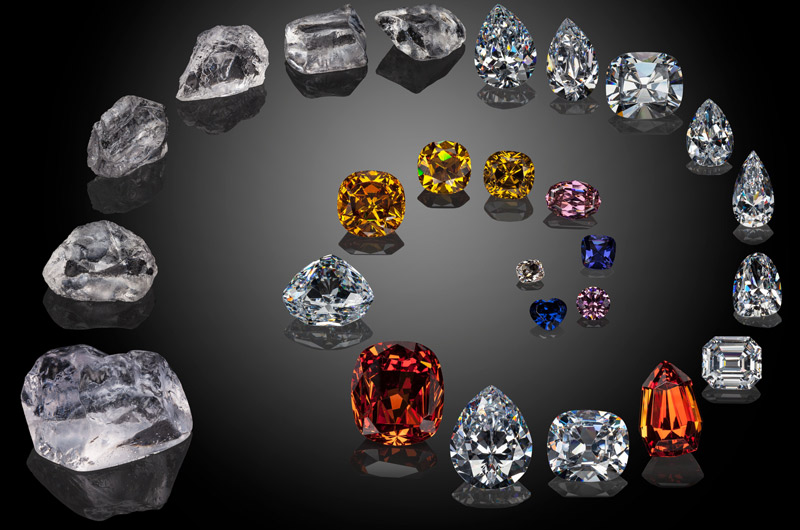
Major Diamond-Producing Countries in Africa — 2026 Production and Revenue
1. Botswana — The World’s Most Valuable Diamond Nation
Botswana produced approximately 21 million carats in 2025, generating export revenue of approximately $2.8 billion — down from a 2023 peak of $3.3 billion as global rough diamond prices faced pressure from the growing lab-grown diamond market, but still representing Botswana’s most important single economic sector by a significant margin.
Diamonds contribute approximately 33% of Botswana’s GDP and account for 80% of the country’s total export earnings — a concentration of resource dependency that the government has been actively managing through the Pula Fund, a sovereign wealth account that holds over $5 billion in accumulated diamond savings for use after the mines are exhausted.
Botswana’s two flagship operations define its diamond sector. Jwaneng Mine, in the Kgalagadi Desert of southern Botswana, is universally acknowledged as the richest diamond mine on earth by value — its 600-metre-deep open pit processes ore that contains an extraordinary proportion of gem-quality diamonds of exceptional colour and clarity.
Orapa Mine, the world’s largest diamond mine by surface area, occupies a 118-hectare pit that has been in continuous production since 1971. Both mines are operated by Debswana — the Botswana government and De Beers joint venture — under a framework that has become the template for ethical large-scale diamond mining globally.
In 2024, Karowe Mine in central Botswana produced the 2,492-carat “Our Lady” diamond — the second-largest gem-quality diamond ever recovered, trailing only the 3,106-carat Cullinan discovered in South Africa in 1905.
The Botswana government’s Gaborone diamond sorting hub now grades approximately 40 million carats per year, and 30 local cutting and polishing factories trained 3,500 Batswana diamond cutters by 2025 — concrete evidence of the government’s commitment to capturing more of the diamond value chain locally rather than exporting all rough to be finished in Antwerp or Tel Aviv.
2. Angola — Africa’s Rising Diamond Champion
Angola produced approximately 10 million carats in 2025, generating approximately $1.6 billion in export revenue — and in a remarkable development, Angola overtook Botswana as Africa’s largest diamond exporter by value in Q3 of 2025, driven by several extraordinary large stone recoveries that pushed the average value per carat significantly above Botswana’s production.
The Catoca Mine in Lunda Sul Province is the world’s fourth-largest kimberlite pit by area and Angola’s dominant producing operation, processed through the state diamond company Endiama’s infrastructure.
Angola’s 2023 sub-soil resources law reserves 20% of new mining concessions for Angolan-owned companies — a legislative commitment to local ownership of resource wealth that reflects the government’s post-war development philosophy.
The country’s Luanda diamond cutting and polishing hub, planned for opening in 2026, will further capture value locally by finishing rough stones within Angola rather than exporting them unprocessed.
3. South Africa — Home of the World’s Most Famous Diamonds
South Africa produced approximately 6.5 million carats in 2025, a relatively modest output by African standards but one distinguished by an extraordinary historical significance and ongoing geological distinction: 80% of all diamonds over 100 carats ever found have come from South African mines.
The Cullinan Mine in Gauteng Province — source of the 3,106-carat Cullinan diamond in 1905, subsequently cut into 9 major stones including two of the largest gems in the British Crown Jewels — remains in active production.
The Venetia Mine in Limpopo Province, De Beers’ largest South African operation, completed its transition from open-pit to underground mining through a $2 billion shaft-sinking project that extends the mine’s life to 2045.
South Africa’s State Diamond Trader reserves 10% of all rough diamond production for purchase by black-owned South African polishing companies under the government’s Broad-Based Black Economic Empowerment framework — a domestic beneficiation policy that is developing local diamond processing expertise within the country.
Our detailed exploration of gold deposits in South Africa provides useful context for understanding how South Africa’s broader mining sector — of which diamonds are a significant but not dominant component — operates.
4. Namibia — The Highest Value per Carat in the World
Namibia produced approximately 2.3 million carats in 2025 — a small number by volume but one representing approximately $1.3 billion in revenue, which translates to a value per carat far higher than any other African producer and among the highest of any diamond-producing nation globally.
The explanation lies in Namibia’s extraordinary geological circumstance: approximately 90% of Namibian diamond production comes from marine operations off the Skeleton Coast, where ancient Namibian river systems carried diamonds from inland kimberlite sources to the Atlantic shoreline over tens of millions of years, then wave action and longshore drift concentrated and sorted the stones by weight — leaving behind only the larger, higher-quality diamonds that survived the mechanical sorting of oceanic transport.
Debmarine Namibia operates a fleet of deep-sea diamond mining vessels including crawler systems that operate at depths of 120 metres, vacuuming six tonnes of seabed gravel per hour for processing through onboard sorting systems.
The result is that Namibian marine diamonds are overwhelmingly VVS and VS clarity — the ocean has performed a natural quality selection that no industrial sorting system can replicate. For gem-quality collectors and jewellery buyers, Namibian marine diamonds represent the apex of African diamond quality.
5. Democratic Republic of Congo — Scale and Complexity
The DRC produced approximately 12 million carats in 2025 — Africa’s second-largest output by volume — but generated only approximately $150 million in export revenue, reflecting the overwhelmingly industrial and low-grade character of most Congolese diamond production.
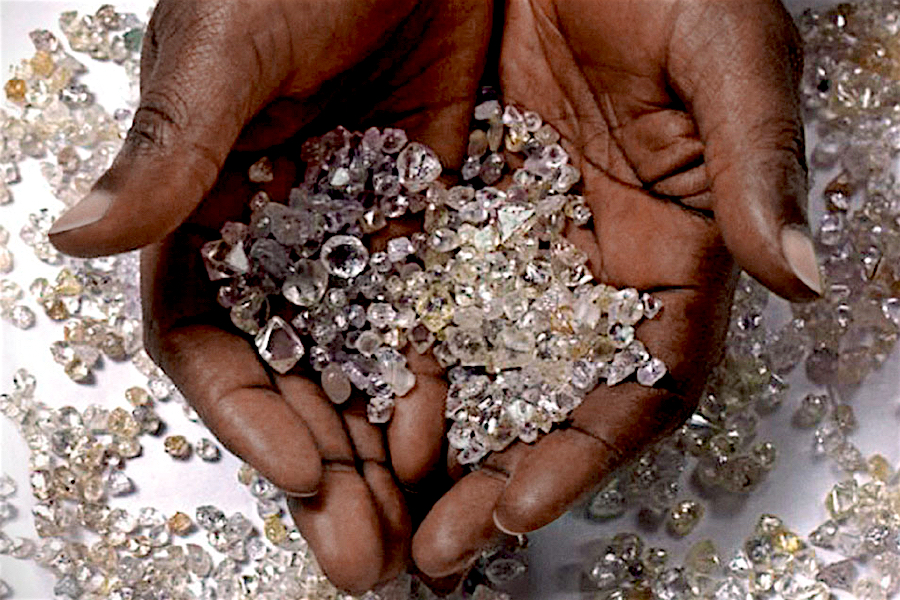
Approximately 1.2 million artisanal and small-scale miners are registered in the DRC’s diamond sector, operating primarily in the Kasai Region’s alluvial fields where diamond grades are relatively low and gem-quality material is a small fraction of total production.
A significant reform development in the DRC diamond sector is the introduction of a mobile traceability application that aims to track artisanal production from individual mining sites through the buying chain to export — a system designed to improve compliance with the Kimberley Process and provide the documentation that international buyers require.
The DRC’s substantial mineral wealth in diamonds, gold, cobalt, and copper makes it a key destination for the African minerals supply relationships maintained by Africa Gold Suppliers Limited.
6. Sierra Leone — Ethical Comeback and Blockchain Innovation
Sierra Leone produced approximately 600,000 carats in 2025 — a small but symbolically significant output from a country whose diamond sector was devastated by its association with conflict mineral financing during the civil war of 1991–2002.
The Koidu Kimberlite Mine in Kono District — one of West Africa’s most historically important diamond operations — restarted production in 2025 with a comprehensive blockchain certification programme that provides verified mine-of-origin documentation for every parcel of rough diamonds.
Sierra Leone’s recovery as a responsible diamond producer is a meaningful demonstration of how the Kimberley Process framework, when properly implemented, can rehabilitate a producing nation’s international standing.
Types and Quality of African Diamonds — Understanding What You Are Buying
African mines yield the full spectrum of diamond quality — from D-colour, internally flawless gems of extraordinary rarity to industrial-grade bort used in drilling and cutting tools. Understanding how different African sources map to the 4Cs quality framework is essential for any serious buyer.
Colour
The finest colourless diamonds — rated D, E, and F on the GIA colour scale — are concentrated in Botswana’s Jwaneng and Orapa mines, where the kimberlite chemistry produces exceptionally colourless stones.
Fancy coloured diamonds — pinks, blues, greens, and oranges — come predominantly from South Africa’s Cullinan Mine (famous for exceptional pink and blue specimens) and from deep Botswana kimberlite sources.
With the closure of Australia’s Argyle mine in 2020, which was the world’s dominant source of pink diamonds, Africa now supplies approximately 70% of global fancy pink diamonds — making South African and Botswanan pink diamonds among the most sought-after investment stones available.
Clarity
Namibian marine diamonds represent Africa’s pinnacle for clarity, with the majority of production grading VS1 or better due to the natural size-sorting effect of ocean transport that selects against heavily included stones. Botswana’s Jwaneng production is similarly strong for clarity, with high proportions of VVS-grade material in its gem-quality output.
Carat Weight
For very large diamonds, South Africa has no peer globally — 80% of all diamonds over 100 carats ever recovered came from South African kimberlite pipes. Botswana’s Karowe mine has produced multiple extraordinary large stones in recent years, including the 2,492-carat “Our Lady” in 2024. The Cullinan Diamond (3,106 carats, recovered 1905) remains the largest gem-quality rough diamond ever found.
The 4Cs Price Reference Table
| Grade | Approximate % of African Output | Typical Price/Carat (2025) |
| D–F / IF–VVS | 12% | $8,000 – $25,000 |
| G–H / VS | 45% | $3,500 – $7,000 |
| I–J / SI | 30% | $1,800 – $3,200 |
| Industrial grade | 13% | $8 – $80 |
The Diamond Mining Process in Africa — From Exploration to Certification
Understanding how African diamonds go from geological deposit to certified rough parcel helps buyers evaluate the documentation they receive and the supply chain they are participating in.
Exploration begins with satellite mapping of magnetic anomalies that indicate kimberlite pipe presence, supplemented by AI-assisted gravity survey analysis that can identify potential pipe locations before any ground-level work begins.
Confirmed targets are drilled and bulk-sampled to evaluate grade (carats per hundred tonnes of ore) and stone quality before a mining development decision is made.
Extraction takes different forms depending on the deposit type. Open-pit mining at Jwaneng currently reaches 600 metres in depth. Underground mining at Venetia’s new $2 billion shaft descends to 1 kilometre below surface.
Alluvial mining in the DRC and Sierra Leone involves artisanal miners sieving riverbeds and gravel terraces. Marine mining off Namibia deploys crawler vehicles that vacuum seabed material at 120 metres depth, processing six tonnes of gravel per hour through onboard sorting systems.
Processing involves crushing and screening the ore to break apart the host rock, followed by dense media separation that exploits diamond’s high density, and X-ray or luminescence sorting systems that trigger ejection of fluorescent diamond particles from the ore stream. Modern diamond sorting technology can identify a single diamond in 10 million particles of host rock.
Sorting and grading at De Beers’ Gaborone hub involves classifying rough diamonds by size, shape, colour, and clarity before allocation to buyers. The Gaborone facility grades approximately 40 million carats per year and is the world’s primary rough diamond sorting centre.
Certification through the Kimberley Process — the international certification scheme for rough diamonds established in 2003 to eliminate conflict diamond financing — requires that all rough diamond exports be accompanied by a government-issued KP certificate with a unique serial number and tamper-proof seal.
As of 2025, the KP has 83 participant countries and recently integrated a simplified audit framework called the WDC-KP Core Document. Blockchain traceability systems operated by Everledger (2 million stones tracked) and De Beers’ Tracr (covering approximately 50% of De Beers production) are complementing KP certification with digital provenance records that cannot be altered.
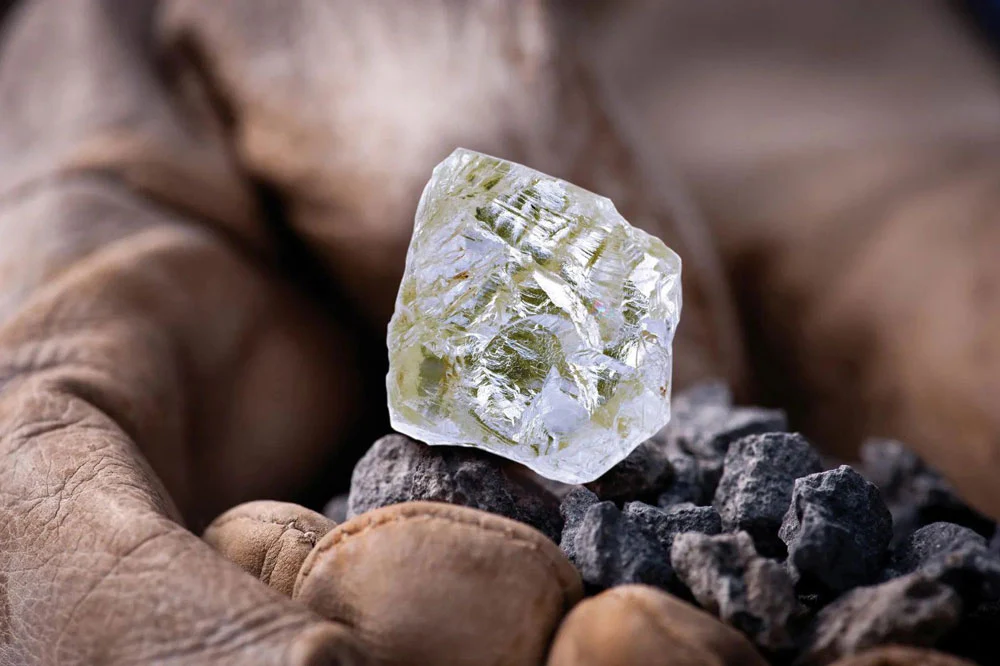
Economic Importance of Diamonds in Africa — Development Impact
| Country | Diamonds as % of GDP | Employment | 2025 Export Revenue |
| Botswana | ~33% | 38,000 formal jobs | $2.8 billion |
| Namibia | ~12% | 10,000 formal jobs | $1.3 billion |
| Angola | ~8% | 25,000 formal jobs | $1.6 billion |
| South Africa | ~2% | 18,000 formal jobs | $1.1 billion |
| DRC | ~1% | 1.2 million artisanal | $150 million |
Beyond the headline numbers, diamonds fund specific development outcomes that would not otherwise exist. Botswana’s Pula Fund — its diamond savings vehicle — holds over $5 billion, providing a buffer against eventual mine depletion. Free university education in Botswana is funded substantially by diamond revenues. Namibia’s social welfare system — among the most comprehensive in sub-Saharan Africa — is built on a diamond revenue foundation. Angola’s post-war infrastructure reconstruction of roads, schools, and hospitals has been largely financed by diamond and oil revenues.
The sector faces genuine structural challenges in 2026. Lab-grown diamonds — manufactured at scale in China and India using chemical vapour deposition technology — have captured approximately 21% of the global polished diamond market by 2025, putting downward pressure on natural rough diamond prices that have fallen approximately 40% from their 2022 peak. Debswana cut production by 16% in 2024–2025 in response to price weakness.
The Luanda Accord of 2025 — signed by major African diamond-producing nations — commits 1% of diamond sales revenue to a “Real is Rare” natural diamond marketing campaign designed to differentiate natural African diamonds from lab-grown alternatives in the consumer market.
Artisanal diamond smuggling costs Africa an estimated $500 million annually in lost revenue, and climate change is affecting diamond operations indirectly — droughts in southern Africa are reducing the hydropower generation capacity that processing plants depend on.
These challenges are real but do not fundamentally alter the extraordinary geological and economic significance of African diamonds.
How to Buy Diamonds from Africa Safely and Legally — 2026 Guide
Buying rough or polished African diamonds directly from licensed sources requires navigating a regulated supply chain with specific documentation requirements at every step. The following guide covers the essential elements of a legitimate, legally compliant African diamond purchase.
Step 1 — Demand the Kimberley Process certificate. Every parcel of rough diamonds exported from an African KP-participant country must be accompanied by a government-issued KP certificate carrying a unique serial number and tamper-proof seal.
Without this certificate, the diamonds cannot legally be imported into any KP-participant country and their provenance cannot be verified. Request the specific KP certificate serial number before any payment is made and verify it with the exporting country’s Kimberley Process authority.
Step 2 — Obtain a GIA or HRD grading report. For polished diamonds, an independent grading report from the Gemological Institute of America (GIA) or HRD Antwerp provides an objective assessment of the stone’s colour, clarity, cut, and carat weight that cannot be manipulated by the seller. For rough parcels, request an independent assay from an accredited gemological laboratory.
Step 3 — Verify the exporter’s licence. The exporting company must hold a valid diamond export licence issued by the relevant national mining authority — Endiama in Angola, the Minerals Commission in Ghana, the Diamond Commissioner’s office in Sierra Leone.
Request a copy of this licence and verify its validity. Africa Gold Suppliers Limited maintains valid mineral dealer licensing for its operations and provides all documentation on request. Our minerals overview page covers the compliance framework for all mineral supply, including diamonds.
Step 4 — Use secure, traceable payment methods. International bank wire transfers to corporate accounts are the standard payment method for legitimate African diamond transactions. Avoid any seller who requests cash, cryptocurrency, informal payment apps, or Western Union transfers — these are consistent indicators of fraudulent operations. For high-value transactions above $100,000, a licensed escrow arrangement adds an additional protective layer.
Step 5 — Arrange insured, specialist shipping. Rough and polished diamonds must travel with declared-value insurance through specialist precious cargo carriers. Domestic and international precious cargo carriers provide GPS-tracked, insured shipment with customs declaration support at both origin and destination. Ensure that your shipment is accompanied by the full documentation package — KP certificate, export licence, commercial invoice, packing list, and (for US destinations) Form 47-01 for customs declaration.
Step 6 — Clear customs correctly. Diamond imports require specific customs documentation in major markets: the US Customs and Border Protection Form 47-01 for diamond imports; the EU KP import certificate for rough diamond imports into European Union member states; Dubai Multi Commodities Centre (DMCC) documentation for UAE imports. Working with a licensed customs broker experienced in precious stones significantly reduces the risk of delays or compliance failures at the destination border.
Trusted Diamond Purchasing Channels in Africa
For buyers seeking direct-source African diamonds with full documentation, the primary legitimate channels are state diamond companies (Debswana for Botswana, Endiama for Angola, Namdeb for Namibia), De Beers’ Gaborone rough diamond tenders, and licensed private exporters with verified documentation and a traceable history of compliant transactions.
Africa Gold Suppliers Limited is one of the few African suppliers who offers both diamonds and certified gold bars under the same compliance and documentation framework — simplifying the sourcing process for buyers who want multiple African precious commodities from a single verified supplier.
Lab-Grown Diamonds vs. Natural African Diamonds — The 2026 Investment Question
The rapid growth of lab-grown diamond (LGD) production has fundamentally changed the diamond market dynamics that buyers must understand before making purchasing decisions.
Lab-grown diamonds are chemically, physically, and optically identical to natural diamonds — the same crystal structure, the same hardness, the same light dispersion.
They are produced using either High Pressure High Temperature (HPHT) processes that replicate the conditions under which natural diamonds form in the earth’s mantle, or Chemical Vapour Deposition (CVD) that grows diamond crystal layers from carbon-rich gas. Manufacturing costs have fallen dramatically, and LGD prices for polished stones are now approximately 70–80% below equivalent natural stones at retail.
The investment case for natural African diamonds versus lab-grown material rests on several structural arguments. Natural diamonds are finite — when a kimberlite pipe is mined out, that source is gone permanently.
Lab-grown diamonds are reproducible in unlimited quantities, which is why their prices continue to fall as manufacturing scale increases. Natural African diamonds retain approximately 92% of their value after five years based on resale data from major auction houses, while lab-grown diamonds have shown value depreciation of 50–70% over the same period as manufacturing costs decline.
For investors seeking a store of value, the rarity premium embedded in natural diamonds — particularly large, high-quality stones from exceptional African sources — provides a return profile that lab-grown production cannot replicate.
The “Real is Rare” campaign funded by the Luanda Accord aims to amplify this message in consumer markets where the distinction between natural and lab-grown is not yet widely understood.
The Future of Diamond Mining in Africa — Technology, Ethics, and Local Value
Africa’s diamond industry is actively reshaping itself for a future in which the assumptions of the 20th century no longer apply. The most important trends shaping the sector through 2026 and beyond are local value addition, technology-driven traceability, and environmental commitment.
Local beneficiation — the processing, cutting, and polishing of rough diamonds within African producer countries rather than shipping all rough to Antwerp, Tel Aviv, or Mumbai — is the most significant structural shift in the sector.
Botswana’s 30 cutting factories, South Africa’s State Diamond Trader programme, and Angola’s planned Luanda polishing hub are all expressions of the same principle: African nations should capture the full value chain of their resource wealth, not merely the mine-gate price.
Blockchain traceability is becoming the standard for premium African diamonds. De Beers’ Tracr platform tracks each stone from mine to consumer, creating an immutable digital record of provenance that can be verified by any downstream buyer. Everledger’s competing platform has similar functionality applied to 2 million individual diamonds. For buyers who prioritise verified ethical sourcing, these systems provide documentation beyond what the Kimberley Process alone can deliver.
Environmental performance is increasingly a competitive differentiator. De Beers’ “Building Forever” programme commits to carbon neutrality in diamond production by 2030. Debswana has invested in solar installations at its Botswana mines.
Namdeb is exploring electrification of its offshore vessel fleet. As global institutional buyers increasingly apply ESG criteria to their procurement decisions, African mines with verifiable environmental performance records will command premium pricing.
Why Buy Diamonds — and Gold — from Africa in 2026?
Africa offers compelling advantages to buyers of diamonds and precious metals that no other source can match across all dimensions simultaneously.
Unmatched gemological quality — the world’s highest proportion of D–F colour, IF–VVS clarity diamonds comes from African mines, particularly Botswana and Namibia. No other diamond-producing region approaches Africa for the combination of volume and quality at the top of the grading scale.
Ethical assurance — 99.8% of African rough diamonds are Kimberley Process certified, and the KP-plus traceability systems now covering a significant portion of African production provide levels of provenance documentation unavailable from other major producing regions.
Direct pricing advantage — sourcing diamonds direct from licensed African exporters rather than through the Antwerp or New York trading chain typically saves buyers 15–30% compared to retail prices, with the saving reflecting the removal of multiple middleman margins rather than any compromise on quality or documentation.
One-stop precious commodity sourcing — Africa Gold Suppliers Limited is one of the few African suppliers offering both diamonds and 24K gold bars, gold dore bars, gold nuggets, and silver bullion from a single documented, licensed source — simplifying the procurement process for buyers who want a full portfolio of African precious commodities under one compliance framework.
To discuss African diamond sourcing — whether for a single gem, a polished parcel, or a rough buying programme — contact Africa Gold Suppliers Limited today. We respond within 24 hours with current availability, KP documentation details, and pricing referenced to live LBMA and rough diamond market benchmarks.

FAQs — Diamonds in Africa 2026
Are African diamonds conflict-free? 99.8% of African rough diamonds are Kimberley Process certified as conflict-free. Always request the KP certificate serial number before purchasing and verify it with the exporting country’s KP authority. Blockchain traceability systems through Tracr and Everledger provide additional provenance verification beyond KP certification for stones processed through those systems.
Which African country produces the best diamonds? The answer depends on what “best” means for your purpose. Botswana produces the highest total value of gem-quality diamonds globally. Namibia produces the highest value per carat, driven by exceptional marine diamond clarity. South Africa produces the largest stones by individual carat weight and is the historic source of the world’s most famous diamonds. For investment-grade large stones, South Africa leads. For consistent gem quality, Botswana and Namibia are the benchmarks.
How much cheaper are African diamonds bought direct? Buyers who source directly from licensed African exporters rather than through established trading chains typically achieve savings of 15–30% compared to equivalent stones at Antwerp or New York retail prices. The saving reflects removal of broker and trading house margins rather than any discount in stone quality.
Can I buy rough diamonds and polished diamonds from Africa? Yes, through licensed exporters. Rough diamonds require full Kimberley Process documentation and comply with import regulations at destination. Polished diamonds travel under standard trade documentation but benefit from GIA or HRD grading reports for value verification. Africa Gold Suppliers Limited can facilitate both rough and polished diamond purchases with complete documentation. See our best place to buy diamonds in Africa page for the full sourcing guide.
Natural African diamonds or lab-grown — which is better for investment? Natural diamonds from African sources retain approximately 92% of value after five years, driven by the finite supply of natural stones and the rarity premium embedded in large, high-quality examples. Lab-grown diamonds are declining in price as manufacturing scales globally, making them poor investment assets despite their suitability as affordable jewellery stones. For buyers seeking value preservation, natural African diamonds have a structurally stronger case.
Related Pages You May Find Useful
- Best Place to Buy Diamonds in Africa — Sourcing Guide
- Minerals for Sale — Diamonds, Copper, Cobalt, Tin
- Gold Bar for Sale — Certified 24K Investment Bars
- Gold Bars for Sale — All Sizes and Weights
- Gold Nuggets from Africa — Natural Alluvial Gold
- Gold Dore Bars for Sale from Africa
- Raw Gold from African Mines
- Silver Bullion Bar — 99.9% Pure Silver
- African Gold Bars for Sale
- Gold Bullion for Sale
- Buy Gold Bars from Africa — International Delivery
- Gold in Africa — Complete Overview
- Gold Producing Countries in Africa — Ranked 2026
- Gold Deposits in Africa — Country-by-Country
- Gold Deposits in South Africa — Geological Overview
- Buy Gold in Congo — DRC Supply Chain
- Gold Mining in Congo — DRC Production Guide
- Gold from Congo — Sourcing and Documentation
- Gold Price in Africa — Regional Pricing Overview
- Gold vs. Silver — Which Is the Better Investment?
- Gold Investment Opportunities in Africa
- Advantages and Disadvantages of Investing in Gold
- Buying Genuine Gold — Fraud Prevention Guide
- How to Buy Gold Online Safely
- Gold and Silver Dealers in Africa
- Gold Smuggling in Africa — Risks for Buyers
- FAQs About Buying Gold in Africa
- About Africa Gold Suppliers Limited
- Contact Africa Gold Suppliers Limited