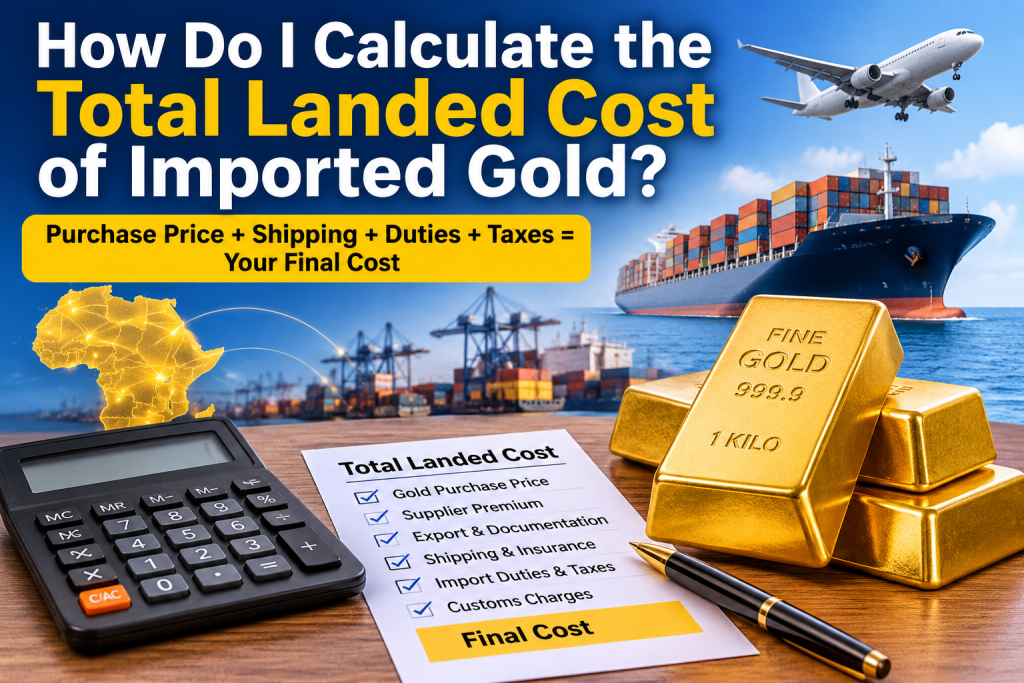
How Do I Calculate the Total Landed Cost of Imported Gold?
The total landed cost of imported gold is the final cost of getting the gold from the supplier to your destination, including all purchasing, export, transportation and import expenses. It helps gold investors, bullion dealers, refiners and jewellery manufacturers understand the actual amount they are paying for each gram or kilogram of gold.
When importing gold from Africa, the supplier’s quotation is only one part of the total expense. Export documentation, independent assay, secure transportation, insurance, customs clearance and destination-country taxes can increase the final cost.
Calculating these expenses before purchasing helps you compare suppliers, prepare an accurate budget and avoid unexpected charges during importation.
How to Calculate the Total Landed Cost of Imported Gold
1. Calculate the Gold Purchase Price
Start with the amount charged by the supplier for the gold itself. The purchase price normally depends on the international gold spot price, the gold’s purity, its weight and the supplier’s premium.
For refined gold, the basic calculation is:
Gold purchase price = Gold weight × Price per gram
For example, if you purchase 1 kilogram of gold at an illustrative price of $120 per gram:
1,000 grams × $120 = $120,000
This is only an example, not a live gold quotation. Actual prices change with the international market.
You should also establish whether the supplier’s price includes refining, assay and other charges or whether these are billed separately.
Read our guide to gold bar prices in Africa to understand how spot prices, purity and dealer premiums affect the purchase price.
2. Include the Supplier’s Premium
Physical gold is commonly sold above its underlying spot value. The additional amount is known as the dealer premium.
It may cover refining, fabrication, handling, certification and the supplier’s operating costs.
For example, if the underlying gold value is $120,000 and the agreed premium is 2%:
$120,000 × 2% = $2,400
Total gold purchase cost:
$120,000 + $2,400 = $122,400
Check whether the premium is already included in your supplier’s quotation. Avoid adding it twice.
3. Add Assay, Refining and Export Documentation Costs
Before gold leaves its country of origin, it may require testing, documentation and regulatory clearance.
Depending on the exporting country and the type of gold, additional expenses may include:
- Independent assay and purity verification.
- Refining or processing charges, where applicable.
- Certificate of origin.
- Export permit and customs documentation.
- Applicable royalties, levies or export charges.
- Inspection and handling fees.
These costs vary according to the exporting country, shipment size and gold specifications.
Request an itemised quotation showing which charges are included in the purchase price and which must be paid separately.
For a detailed list of paperwork, see our gold export documents checklist.
4. Calculate International Shipping Costs
Transportation is another important part of the total landed cost of imported gold.
Gold is generally transported using specialist precious-metals logistics services or appropriately declared valuable air cargo. The shipping cost depends on the weight and value of the shipment, destination, route, security arrangements and carrier.
Ask for a written shipping quotation that identifies:
- Collection and handling charges.
- Secure transportation or air freight.
- Airport and cargo handling fees.
- Customs brokerage services.
- Destination delivery or vault charges, where applicable.
Also agree on the delivery terms, including the point at which transportation responsibilities and risks transfer from the seller to the buyer.
Learn more about shipping and insuring gold internationally.
5. Include Gold Shipment Insurance
Insurance protects against covered losses or damage during transportation. However, not every policy automatically covers bullion or the full journey.
Ask the insurer to confirm the insured value, coverage period, exclusions, security conditions and claims procedure.
For example, insurance may cover transportation between specified locations but exclude storage or certain customs-related losses.
Do not assume that a shipping quotation includes adequate insurance. Request the insurance certificate and confirm that the actual gold shipment is covered.
6. Add Import Duties, Taxes and Customs Clearance Fees
The destination country’s import rules can significantly affect the final landed cost.
Depending on the country, gold type and applicable tax treatment, you may need to account for:
- Import duty, where applicable.
- Value-added tax (VAT) or goods and services tax (GST), where applicable.
- Customs processing charges.
- Customs broker fees.
- Inspection and handling fees.
- Storage charges if clearance is delayed.
Tax treatment differs between countries and may depend on whether the imported product is investment-grade bullion, doré or another form of gold.
Confirm the applicable customs classification, duties and taxes with the destination country’s customs authority or a qualified customs broker before placing your order.
Our guide to importing gold from Africa explains the documentation and import considerations buyers should review.
7. Use the Total Landed Cost Formula
Once you have collected all the relevant quotations and charges, combine them to calculate the final cost.
Total Landed Cost = Gold Purchase Price + Supplier Premium + Assay and Export Costs + Shipping + Insurance + Import Duties and Taxes + Customs and Handling Fees + Other Applicable Charges
You can then calculate the landed cost per gram:
Landed Cost per Gram = Total Landed Cost ÷ Total Gold Weight in Grams
For example, consider this illustrative 1 kg gold import:
| Cost component | Example amount |
|---|---|
| Gold purchase price | $120,000 |
| Supplier premium | $2,400 |
| Assay and export documentation | $600 |
| Shipping | $800 |
| Insurance | $300 |
| Customs and brokerage | $400 |
| Import taxes and duties | $1,500 |
| Total landed cost | $126,000 |
In this example:
- Total shipment weight: 1,000 grams
- Total landed cost: $126,000
- Landed cost per gram: $126
- Landed cost per kilogram: $126,000
These figures are hypothetical and do not represent actual shipping quotations, taxes or current gold prices. Your final calculation should use the charges applicable to your specific shipment and destination.
8. Request an Itemised Landed Cost Quotation
Before confirming an import order, request a written quotation that separates the gold value from all additional expenses.
This makes it easier to identify hidden costs, compare suppliers and understand the final amount payable.
Africa Gold Suppliers Ltd provides information about gold sourcing, export documentation, pricing and international shipping through its official website.
Buyers can also review its guide to choosing a reliable gold supplier in Africa before committing to a transaction.
Final Considerations
Calculating the total landed cost of imported gold requires adding every expense involved in purchasing, exporting, transporting and clearing the shipment. The most important figures to verify are the gold purchase price, supplier premium, export charges, shipping, insurance, customs fees and destination-country taxes.
Always use actual written quotations rather than estimates when preparing your import budget. Once you know the total landed cost, divide it by the gold’s weight to establish your true cost per gram or kilogram.
This gives you a more accurate basis for comparing suppliers, evaluating resale prices and making informed gold purchasing decisions.